
Anthropic shipped something yesterday that I haven't stopped thinking about.
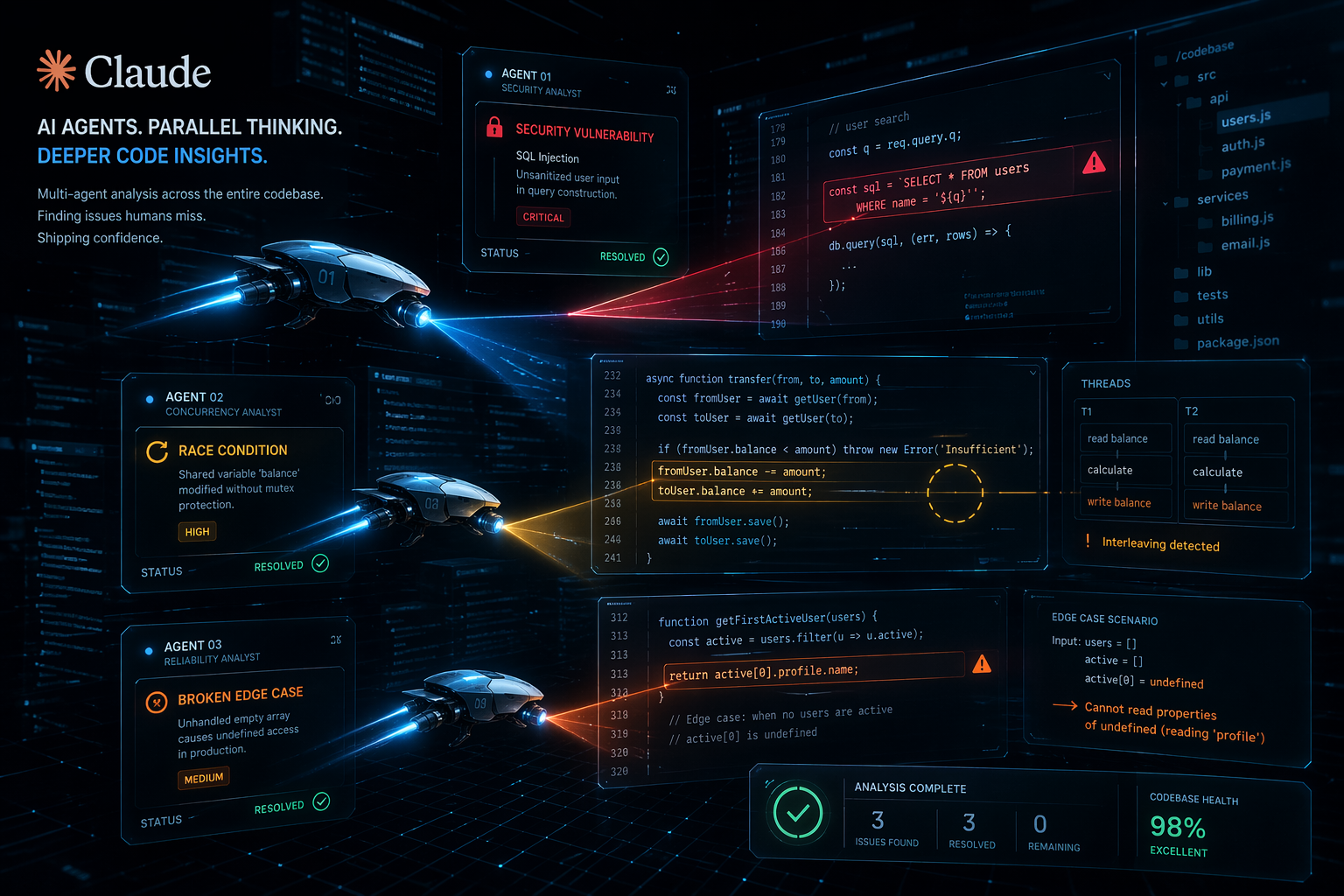
It's called /ultrareview. It's a research preview inside Claude Code, available from v2.1.86. The basic premise is simple: instead of one model doing a single pass on your diff, it spins up a fleet of specialized agents in the cloud and has them hunt bugs in parallel.
One agent looks at security. Another checks race conditions. Another traces through your data migration paths. They all work at the same time, on your actual codebase, with full context.
The part that makes this different from every other AI code review tool I've tried: every finding is independently reproduced before you see it. The agents don't just flag "this might be a problem." They verify it. They show you exactly how the bug happens.
That changes the signal-to-noise ratio completely.
What Normal AI Review Looks Like
If you've used basic AI review, you know the experience. You get 40 comments. 30 of them are style suggestions. 5 are reasonable observations you already knew. 3 are confusing. 2 are actually useful.
You skim it, close it, and ship anyway because you don't have time to figure out which 2 comments matter.
The noise isn't just annoying. It trains you to ignore the output entirely.
What Reproduced Findings Change
When a finding comes with a reproduction, you immediately understand the severity. You're not reading "this function might cause issues under concurrent load." You're reading a sequence of two API calls and the exact state they leave your database in.
Think about the class of bugs this is actually good at catching. Auth flows where the logic is spread across three middleware layers. Payment handlers that are idempotent on paper but not in practice. Migration scripts that look fine on your dev database but behave differently at production scale. These are the bugs that are genuinely hard to catch in review because catching them requires holding a lot of state in your head simultaneously.
Fleets of agents don't have that problem.
The Honest Cost Conversation
This is not a free tool, and it's not trying to be.
Pro and Max users get 3 free runs through May 5, 2026. After that, each review costs $5 to $20 depending on diff size and codebase complexity. The process takes 10 to 20 minutes.
That math makes it wrong for every commit. It makes it very right for the merges that keep you up at night.
Authentication logic. Payment flows. Database migrations. Anything where a bug means you're calling customers at 2am. The mental reframe I'd suggest: stop thinking of it as a code review tool and start thinking of it as a pre-deployment audit for high-risk paths.
Where This Matters Most
Small teams and solo devs have had bad options here for a long time. You either skip review, ask a colleague to glance at your PR, or pay for tools that mostly catch what your linter would have caught anyway.
A verified, parallel review of your most dangerous code paths for roughly $10 is a genuinely new option. It doesn't replace a human reviewer who knows your product and your customers. It replaces the uneasy feeling before you merge the auth refactor at midnight.
A Note on This Being a Research Preview
Some early users are reporting crashes. Some are reporting higher than expected costs on complex runs. Anthropic is actively collecting feedback and the feature will evolve.
Use your free runs on your scariest open diffs. That's the fastest honest test of whether it belongs in your workflow.
If it catches one real bug before a production deploy, it's already paid for itself.