
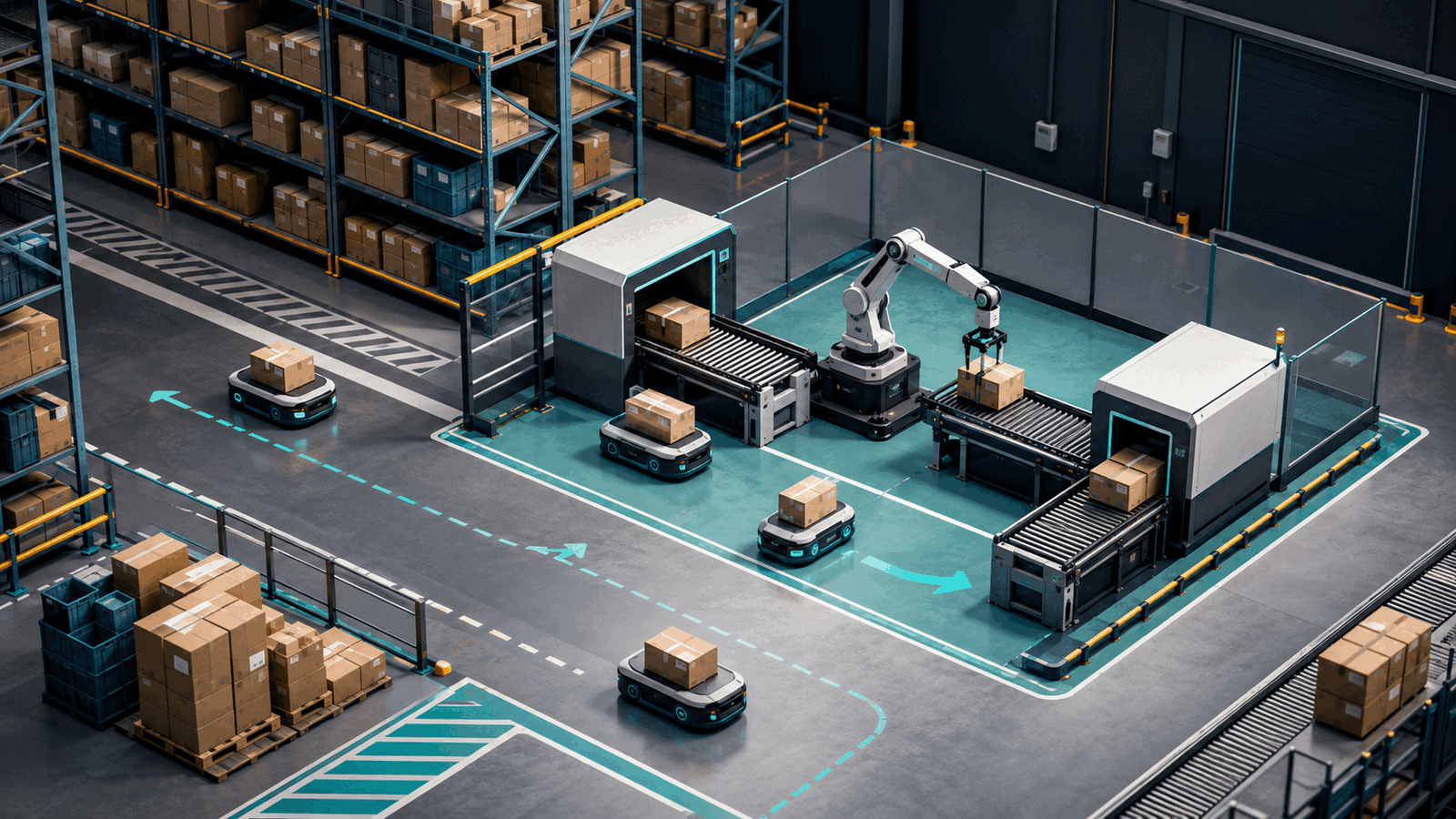
Google DeepMind showed Gemini Robotics 2 controlling an Apptronik Apollo 2 humanoid from its feet to its fingertips on July 30. The robot could walk to a shelf, pick up a watering can, and place it in the requested bin. Impressive. It is still not a reason for a warehouse owner to order humanoids.
The business question is less exciting and more useful: can automation reduce the cost of moving each unit without creating a safety, maintenance, or integration problem?
We think many warehouse automation projects start at the wrong end. They begin with a machine and search for work to give it. A better project starts with one expensive movement, measures it, and selects the simplest system that can improve it.
What Gemini Robotics 2 actually changes
Most warehouse robots follow narrow instructions. A mobile robot carries a rack along mapped routes. A robotic arm repeats a motion inside a fixed cell. Those systems can work well because the environment and task are tightly controlled.
Gemini Robotics 2 is designed for messier situations. It combines what a robot sees, what a person asks, and the movements needed to complete the task. The industry calls this a vision language action model. In plain language, it turns camera input and an instruction into physical action.
DeepMind reports that the model can control a full humanoid body, adapt to new robot designs with a few hours of data, and coordinate multiple robots. Its separate reasoning model can also watch progress and verify whether a task was completed.
That matters because warehouses contain exceptions. A carton is dented. A tote is in the wrong position. An aisle is blocked. More adaptable software could reduce the amount of custom programming needed for every variation.
But the published results also show the limit. In DeepMind's own evaluation, an Apollo robot picked items from the floor successfully 45.7% of the time. Several multi-finger tasks were below 50%. Research progress is moving quickly, but a demo is not an operating guarantee.
Do not automate a job title
"Automate warehouse picking" sounds like a project. It is not specific enough to price or test.
A warehouse worker may scan an item, judge damaged packaging, choose a container, walk to another zone, clear a jam, and answer a supervisor's question during one task. A general-purpose humanoid would need to handle all of those conditions safely. That is a difficult first deployment.
Start with a bounded movement instead. Moving sealed totes between two known points is easier to control than picking mixed loose items from unpredictable shelves. Pallet inspection in a marked area may be easier than unloading a trailer with shifting loads.
The right first task has four properties:
-
It happens often enough to matter
-
Its starting and ending conditions can be measured
-
Exceptions can be routed to a person
-
Failure does not stop the entire facility
This is not timid automation. It is how a business learns what the equipment can do without putting daily orders at risk.
Run the payback math before the pilot
Warehouse robotics vendors often lead with labor savings. That number can be misleading if it ignores maintenance, integration, facility changes, and the people needed to manage exceptions.
Consider a hypothetical task that costs ₹4 million a year in labor and operational overhead. Suppose the first deployment costs ₹6 million, annual support costs ₹600,000, and the system reliably removes 40% of the task cost.
The annual gross saving is ₹1.6 million. After support, the net saving is ₹1 million, so the simple payback period is six years. For most growing businesses, that is too slow for equipment exposed to technical change and operating wear.
Now use the same system on a task costing ₹10 million a year. A 40% reduction produces ₹4 million in gross annual savings. After support, the ₹6 million investment pays back in less than two years. That case deserves a closer look.
These are illustrative numbers, not a vendor quote. The point is that the same robot can be a poor investment in one facility and a sensible one in another. Volume, utilization, exception rates, and the cost of downtime decide the result.
Measure the movement, not the demo
Before bringing equipment onto the floor, record a baseline for at least two normal operating weeks. Peak season is useful too, but it should not be the only sample.
Track cost per unit moved, units per labor hour, exception rate, and unplanned downtime. Record near misses and ergonomic incidents as well. Safety improvements can justify a project even when the direct labor payback is modest, but only if the team measures them.
Then run the pilot in one zone with a human fallback. Compare the automated zone with a similar area using the current process. A successful 20-minute demonstration proves almost nothing. A useful pilot survives shift changes, damaged labels, congestion, and a week when demand does not match the forecast.
Amazon offers a valuable scale reference. The company says it has deployed one million robots across more than 300 facilities. Its DeepFleet system, which coordinates robot movement like a traffic controller, improved fleet travel time by 10%.
Ten percent is meaningful at Amazon's volume. A smaller operator should not copy that result into a spreadsheet and call it expected ROI. Amazon has years of movement data, purpose-built facilities, and dedicated robotics teams. Your baseline will be different.
Simpler automation often wins
Humanoid robots attract attention because they can fit spaces designed for people. That flexibility could become valuable in older facilities where rebuilding every aisle is impractical.
Today, a conveyor, autonomous mobile robot, fixed arm, or software change may solve the same bottleneck with less risk. If the task never needs legs or five-finger dexterity, paying for them is hard to defend.
We would reject a humanoid pilot when the process is stable enough for conventional automation, the task volume is low, or the facility cannot support trained maintenance staff. We would also reject it when management cannot provide a credible cost baseline. Without that number, the pilot becomes theatre.
More adaptive robotics is worth testing when product mix changes frequently, the building cannot be redesigned cheaply, or several related tasks could share one machine. Even then, the test needs a narrow starting point.
Buy the machine, build the operating layer
Most companies should not design their own robot hardware or safety controller. Those components require specialist engineering, field support, and certification. Buy a proven platform where one exists.
Custom development becomes valuable around the machine. A warehouse management system needs to release the right task. Inventory records must update when the robot finishes. Cameras and sensors need to flag exceptions. A supervisor needs one place to pause work, approve a recovery action, and understand why throughput dropped.
This operating layer is where many pilots stall. The robot works, but it is isolated from orders, inventory, and human decisions. Staff then copy data between systems or manually rescue tasks, which destroys the planned saving.
The first version does not need to run the whole warehouse. It needs to connect one workflow from request to verified completion, keep an audit trail, and make failure visible before it affects a customer order.
Gemini Robotics 2 is a real technical step. It does not remove the need for process design or disciplined ROI measurement. If anything, more capable robots make those choices more important because they make bigger projects look possible.
Axentia builds the AI and full-stack software that connects operational workflows, business systems, and approval controls. If you are evaluating warehouse automation and want to test the economics before committing to a large rollout, book a call with us. We can map one workflow worth proving.