
StepFun recently released an open model named Step 3.7 Flash, and it is worth paying attention to even if you never plan to read a line of its code.
Most AI news over the last two years has been about models getting bigger and smarter. The story with Step 3.7 Flash is different. It is built to be fast, cheap, and reliable at doing actual work, not just answering questions. That focus has a name now, and people are calling it agent efficiency.
What agent efficiency actually means
An agent does more than answer you. It takes steps. It reads a chart, writes some code, runs a search, checks the result, and tries again. Every one of those steps costs time and money. If the model is slow or unreliable, those costs pile up fast and the whole thing becomes impractical.
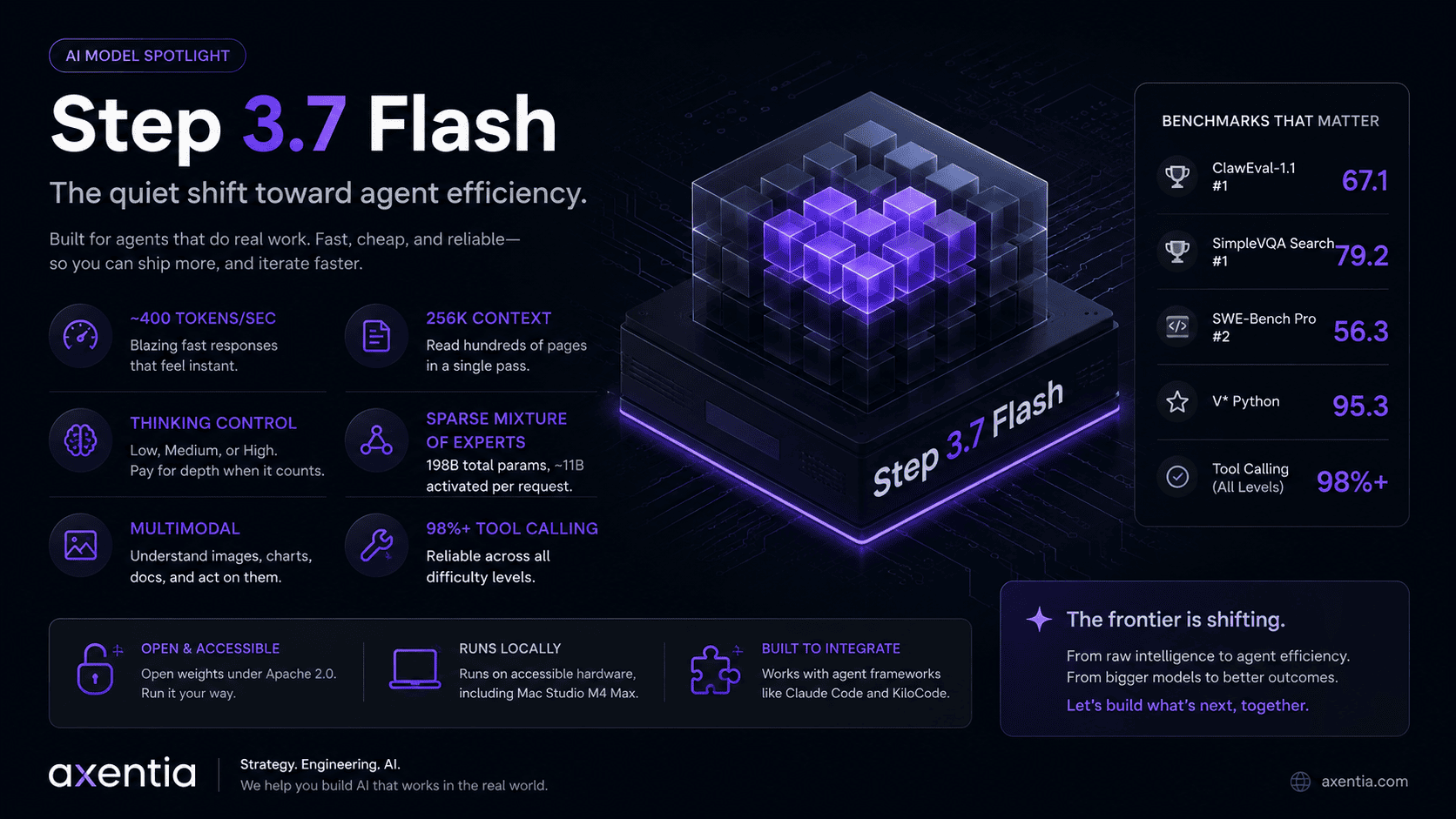
Step 3.7 Flash is designed around that problem. It runs at around 400 tokens per second, which means responses feel close to instant. It can hold 256,000 tokens of context, roughly a few hundred pages, so it can read a long financial report or an entire codebase in one pass. And it lets you pick how hard it thinks, low, medium, or high, so you only pay for deep reasoning when the task actually needs it.
The technical trick underneath
The model has 198 billion total parameters but only activates about 11 billion of them for any given request. Think of it as a large company where only the relevant specialists get pulled into each meeting. You get the knowledge of a big model with a running cost closer to a small one. This design is called a sparse mixture of experts, and it is the main reason the speed and price look the way they do.
The numbers that matter
Benchmarks are imperfect, but the pattern here is clear. Step 3.7 Flash ranks first on ClawEval-1.1 with 67.1 and SimpleVQA Search with 79.2, comes second on SWE-Bench Pro with 56.3, a hard real-world coding test, and scores 95.3 on V* Python. It also clears 98 percent on a tool-calling benchmark across every difficulty level, which speaks to reliability. In plain terms, it breaks fewer times when asked to use tools and chain steps together.
It is also multimodal. It can look at a product interface, a chart, or a scanned document, understand it, and then write code or call a tool to act on what it sees.
The practical upside for builders
Two things stand out for anyone building a product.
First, it ships as open weights under Apache 2.0, so you can run it yourself without paying a closed provider for every request. It already plugs into agent frameworks like Claude Code and KiloCode, so adoption does not require rewiring your stack.
Second, it runs locally on accessible hardware, including a Mac Studio M4 Max. A capable agent model sitting on a machine on your desk changes the math on privacy, cost, and control.
The bigger takeaway is about direction. The frontier is no longer only about raw intelligence. It is increasingly about models cheap and dependable enough to put to work at scale. The hard part is rarely the model itself. It is figuring out where it fits in your product and how to ship it without breaking things.
That is the work we do at Axentia. If you are weighing whether a model like this belongs in what you are building, we are happy to think it through with you.