
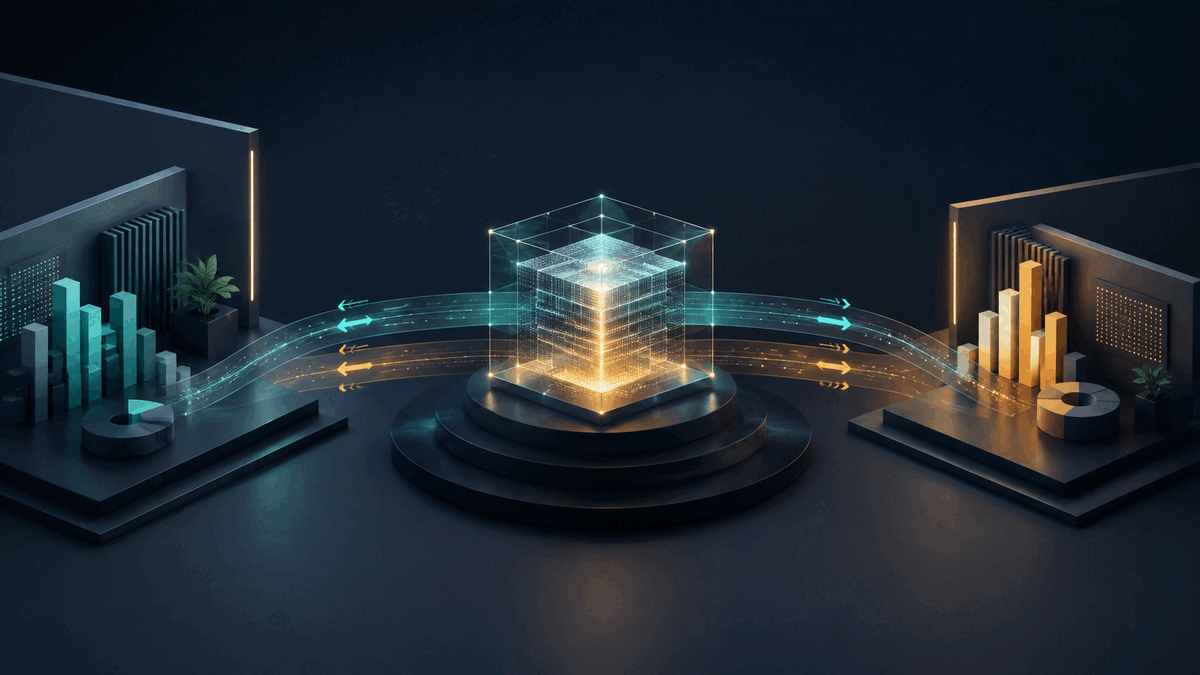
SAP and Google Cloud made BDC Connect for BigQuery generally available on July 27. The product lets a company analyze SAP data in BigQuery without first creating another physical copy. If your team maintains 12 separate data pipelines between the two systems, that changes a real cost line, not just an architecture diagram.
Most data projects do not become expensive because storage is expensive. They become expensive because somebody has to build each copy, monitor it, repair failed loads, reconcile mismatched numbers, and explain why yesterday's inventory is showing in today's report.
We think companies have accepted this duplication for too long. Copying data should be a deliberate choice for a specific reason, not the default price of asking a business question.
Why SAP data gets copied in the first place
SAP often holds the operational record for finance, procurement, inventory, or manufacturing. BigQuery is built for large analytical queries and combining data from many sources.
Traditionally, a company wanting SAP data in BigQuery builds a pipeline. That pipeline extracts selected records from SAP, transforms them into a different structure, and loads a copy into Google Cloud. The process is commonly called ETL, which means extract, transform, and load.
The first load is not the hard part.
SAP data changes. Tables evolve. A field is renamed. A job fails halfway through the night. The team needs rules for late records, deleted records, access control, and recovery. Every copy creates another place where the same business fact can disagree with itself.
That disagreement reaches the boardroom. Finance sees one revenue number in SAP while an analytics dashboard shows another because its pipeline ran two hours earlier. Both systems may be working exactly as designed. The decision-maker still has to guess which number is current.
What zero-copy means in plain language
SAP Business Data Cloud Connect for BigQuery creates a controlled connection between SAP Business Data Cloud and BigQuery. Each platform can access approved data products in the other without moving the underlying dataset into a duplicate store.
Think of it as granting access to one governed warehouse shelf instead of shipping a photocopy of every box to another building.
The connection is bidirectional. BigQuery can access SAP tables, metadata, and business meaning. SAP can also use enriched data made available from Google Cloud.
Business meaning matters more than it sounds. A raw database field named NETWR is not useful to most people. SAP's metadata can preserve the fact that the field represents a net order value, which currency applies, and how it relates to a customer or sales document.
That context reduces a common AI failure. A model can calculate confidently from the wrong column when it sees only raw fields. Giving it governed business definitions does not guarantee a correct answer, but it removes one avoidable source of confusion.
The cost case is pipeline maintenance
Google says the zero-copy connection has no data-sharing fee and reduces the need to store duplicate data. That is useful. The larger saving may be the engineering work around replication.
Consider a hypothetical manufacturer maintaining 12 SAP-to-analytics pipelines. Each pipeline takes eight hours a month to monitor, reconcile, update, and support. At a blended engineering cost of $80 an hour, the annual maintenance cost is:
12 pipelines x 8 hours x $80 x 12 months = $92,160
Suppose zero-copy access removes 75% of that work while the company keeps a few copies for regulatory snapshots and specialized processing. The recovered engineering capacity is about $69,000 a year.
Those are illustrative numbers, not an SAP or Google quote. Your result depends on how many pipelines exist, how often they break, and whether the same team can retire them after the new connection is live.
Do not count a pipeline as removed merely because a new dashboard works. Retire its schedules, storage, alerts, credentials, and support ownership. Otherwise the business pays for the old path and the new one at the same time.
Zero-copy does not mean zero cost
The phrase sounds more generous than the billing model really is.
BigQuery still charges for compute when queries run. Its current on-demand price starts at $6.25 per tebibyte processed after the monthly free allowance. Capacity pricing is another option. SAP licensing and the Business Data Cloud environment remain separate considerations.
The connection also needs implementation work. Someone must define which data products are shared, map permissions, test performance, and confirm that reports still follow finance and operational rules.
Zero-copy removes a category of movement and duplication. It does not remove query cost, governance work, or data quality problems.
That limitation is important. A badly defined customer record stays badly defined when accessed in real time. Faster access to unclear data can make a wrong decision arrive sooner.
When this SAP BigQuery integration is worth testing
The strongest candidates already use SAP Business Data Cloud and BigQuery, or have committed to both platforms. They also have a visible replication problem.
Look for one of these signals:
-
Important reports are hours or days behind SAP
-
Engineers regularly repair or reconcile copy jobs
-
Several departments store different versions of the same SAP data
-
An AI project is blocked because operational context is missing
-
Storage and pipeline ownership are spread across several vendors
Google says BDC Connect for BigQuery is generally available globally. SAP Business Data Cloud is available in the Mumbai Google Cloud region, among others. The connection supports SAP Business Data Cloud instances hosted on Google Cloud and AWS, while Azure support is listed as coming soon.
That availability does not mean every SAP customer should migrate immediately.
If a company has one stable nightly export feeding three reports, replacing it may save less than the project costs. A smaller business using SAP Business One may not have the required Business Data Cloud setup. Teams that need an immutable historical snapshot may still choose to copy specific datasets.
Zero-copy is a strong option when duplication is already an operating burden. It is not a universal rule against replication.
Start with one decision, not the whole data estate
Do not begin by connecting every SAP domain to every BigQuery project.
Choose one business decision that suffers from stale or fragmented data. Inventory planning is a good example. A team may combine live stock levels from SAP with demand signals, supplier lead times, and external market data in BigQuery.
Record the current baseline:
-
How old the SAP data is when the report runs
-
How many engineer hours the pipeline consumes each month
-
How often reconciliation finds a mismatch
-
What the current query and storage costs are
-
Who can see sensitive fields
Then expose only the approved data product needed for that use case. Rebuild the report or workflow against the shared source. Run the old and new paths side by side for a defined period, compare the output, and retire the old pipeline only after the business owner signs off.
The pilot should answer a financial question. Did reporting become more current? Did support work fall? Did the team avoid another copy? Did the decision arrive early enough to change an order or prevent downtime?
If the answer is only that the architecture looks cleaner, the project is not finished.
Buy the connection and build the workflow
Recreating SAP and Google's zero-copy layer would be an expensive mistake. Use the supported product when its commercial terms and platform requirements fit.
Custom development belongs around the connection.
A company may need to combine shared SAP inventory with a supplier portal, create an approval path for purchasing changes, or alert an operations leader when stock and demand move outside an agreed range. It may need a role-based application that lets a regional manager act without exposing the entire finance dataset.
That is where a software partner adds value. The goal is not to move more data. It is to turn one governed source into a faster business action.
SAP and Google Cloud have removed a large piece of the plumbing for companies already inside their ecosystems. The hard work now is choosing the right data product, keeping access narrow, and connecting the insight to a decision somebody owns.
Axentia builds full-stack applications, data integrations, and AI workflows around the systems businesses already run. If your SAP analytics stack is carrying duplicate pipelines and you want to test one zero-copy use case before a wider rollout, book a call with us. We can help map the cost of the current path and build the smallest useful replacement.