
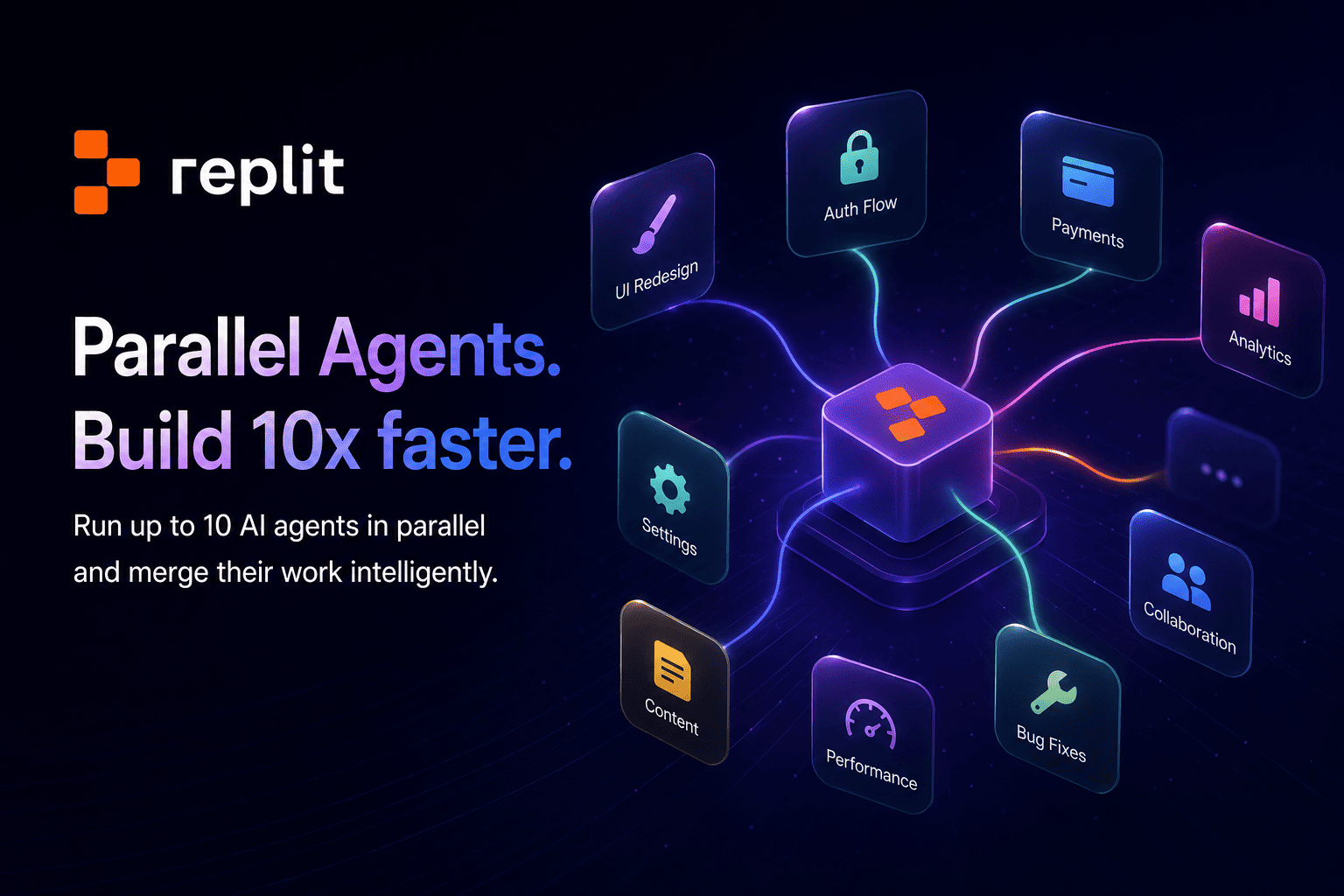
Replit just launched Parallel Agents, and the idea is simple: instead of asking one AI agent to build features one after another, you can now run up to 10 agents at the same time on the same project.
Each agent gets its own copy of your app. One can work on the landing page. Another can build authentication. Another can add payments. Another can improve collaboration features. Once the work is done, Replit brings those changes back into the main app and tries to handle the merge intelligently.
This is not just another coding assistant feature. It is a shift in how software gets built.
What Parallel Agents Actually Changes
Most AI coding tools today still work like a very fast junior developer. You give one instruction, it makes changes, you review them, then you move to the next task. That is useful, but it is still mostly sequential.
Parallel Agents changes the workflow from "one AI helper" to "a small AI team."
The developer's role starts moving away from writing every line or even prompting every small change. Instead, you become the person assigning work, reviewing output, deciding what ships, and making sure the whole product still makes sense.
That is a big deal for solo builders and small teams. A founder who previously needed three developers for three different feature tracks can now at least attempt to run those tracks in parallel. Not perfectly. Not without review. But much faster than before.
The Productivity Upside Is Real
There are many cases where this makes obvious sense. You can ask one agent to restyle a dashboard, another to add onboarding, another to clean up copy, and another to prototype a pricing page. These tasks are related, but they do not all need to happen one after another.
That is where parallelism shines.
A lot of software work is not blocked by deep architectural decisions. It is blocked by time, attention, and task switching. Parallel Agents attacks that bottleneck directly. It lets builders explore multiple versions, ship UI faster, and convert vague product ideas into working surfaces quickly.
For early stage products, this is extremely powerful. The speed of iteration matters. The number of ideas you can test in a day matters. The difference between "we will try this next week" and "we tested four versions today" can change the direction of a product.
The Part People Should Be Careful About
The risk is that parallel work also creates parallel review debt.
When 10 agents change 10 parts of your app, the hard part is not only merging code. The hard part is understanding whether the final product still behaves correctly. Merge conflicts are one problem. Shared state, inconsistent assumptions, broken flows, hidden bugs, and duplicated logic are much bigger problems.
An agent might build a payments page that assumes one pricing model. Another might build onboarding around a different user type. Another might change the dashboard data shape without realizing how it affects analytics. Individually, each change may look fine. Together, they can quietly break the app.
This is especially true for vibe-coded apps, where the founder or team may not have a complete mental model of the system. When the codebase is already partially generated, parallel generation can make it harder to know what is actually happening underneath.
What This Means for Builders
Parallel Agents is a glimpse of where AI development is going. Software teams will become smaller, faster, and more orchestration-heavy. The best builders will not just be the ones who can prompt well. They will be the ones who can review well.
Use tools like this aggressively for speed. Let agents explore, prototype, refactor, and build in parallel. But do not confuse faster output with safer output.
The human job becomes more important, not less. Someone still has to own the product logic. Someone still has to know what should never happen. Someone still has to check auth, payments, data access, edge cases, and user flows before shipping.
Replit Parallel Agents makes one builder feel like a team.
But someone still has to manage the team.