
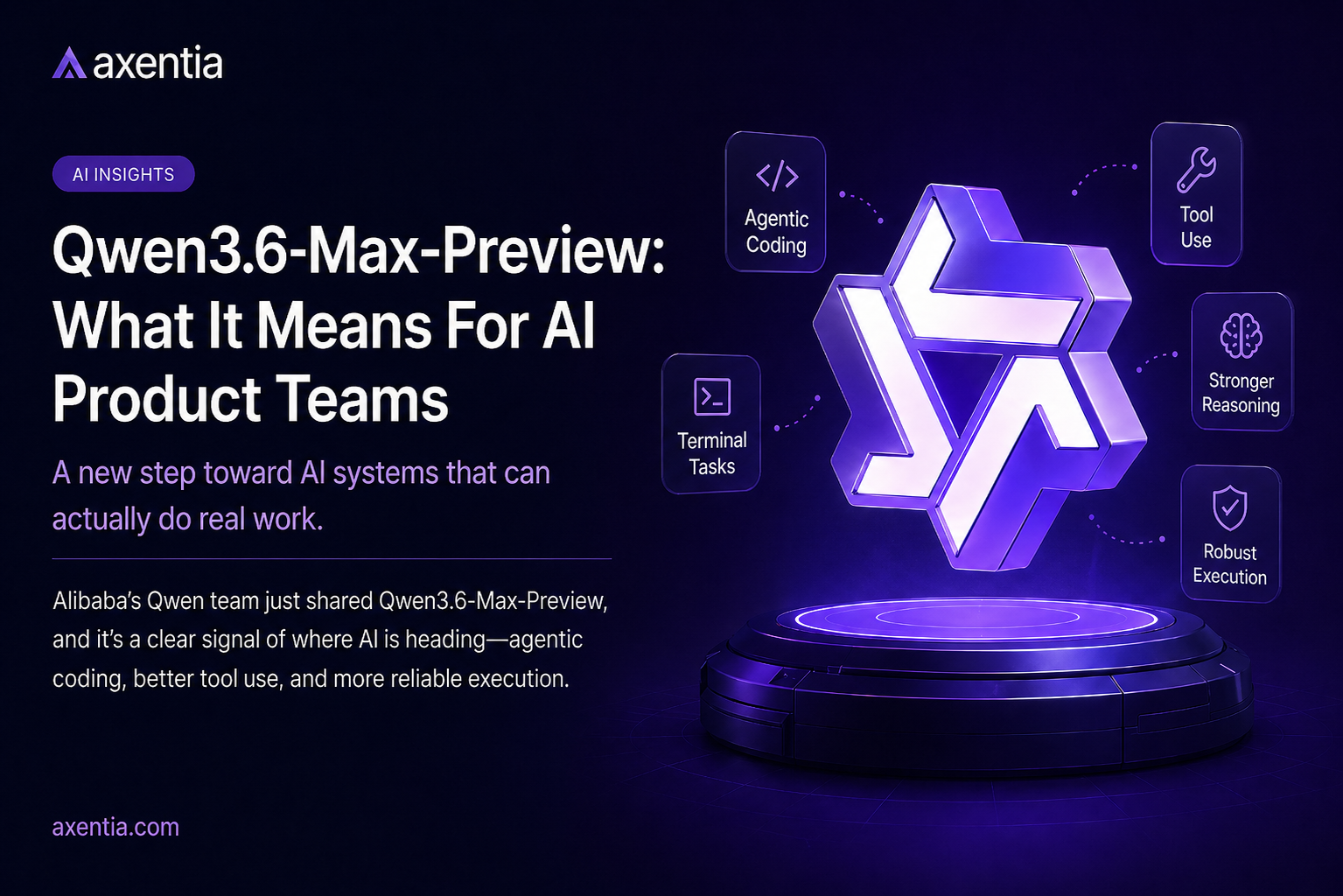
Alibaba recently shared Qwen3.6-Max-Preview, an early preview of its next proprietary model.
At first, it looks like another AI model announcement with better benchmark numbers.
But the more interesting part is not just the benchmarks.
It is where the improvements are focused.
Agentic coding.
Tool use.
Instruction following.
Longer workflows.
More reliable execution.
That tells us something important about where AI products are heading.
What Is Qwen3.6-Max-Preview?
Qwen3.6-Max-Preview is Alibaba’s newer preview model built to perform better across coding, reasoning, tool use, and agentic workflows.
In simple terms, it is not just trying to answer questions better.
It is trying to do work better.
That means understanding repositories, following instructions, using tools correctly, handling multi-step tasks, and staying useful across longer workflows.
Why Does This Matter?
AI products are moving beyond simple chatbots.
The next serious wave is AI systems that can take action.
For example:
• Review code
• Debug issues
• Write tests
• Use internal tools
• Understand business logic
• Work across multiple files
• Follow product constraints
This matters because real product teams do not just need smart responses.
They need reliable execution.
A model that gives a good answer in one prompt is useful.
A model that can work inside a messy production workflow is much more valuable.
When Should Teams Pay Attention To This?
Teams should pay attention when they are building AI products that involve:
• Code generation
• AI agents
• Workflow automation
• Internal copilots
• Customer support automation
• Data-heavy reasoning
• Tool-based systems
If your AI product only answers simple questions, this may not matter immediately.
But if your product depends on multi-step tasks, tool calling, context management, or code understanding, then models like Qwen3.6-Max-Preview are worth watching.
What Should Teams Be Careful About?
The mistake would be to look at benchmark numbers and assume the model is automatically production-ready.
That is not how real AI products work.
A model can perform well on public benchmarks and still fail inside your actual product.
It may misunderstand your codebase.
It may ignore business rules.
It may call the wrong tool.
It may increase token cost.
It may introduce security issues.
It may fail on edge cases.
So the real question is not:
“Which model is the smartest?”
The real question is:
“Which model works reliably for our product, our users, and our constraints?”
How Should Product Teams Think About It?
The model is only one part of the system.
The real work is around the model.
That includes:
• Context management
• Model routing
• Tool permissions
• Eval pipelines
• Cost tracking
• Security checks
• Human approval flows
• Observability
This is where AI product engineering becomes important.
You cannot just plug in the latest model and expect a reliable product.
You need to design the full system around how the model will behave in production.
Final Thoughts
Qwen3.6-Max-Preview is worth paying attention to because it shows where AI models are going.
They are not just becoming better at answering.
They are becoming better at executing.
For product teams, that is the bigger shift.
The future will not belong to teams that simply use the latest model.
It will belong to teams that know how to turn these models into reliable, useful, and safe product experiences.