
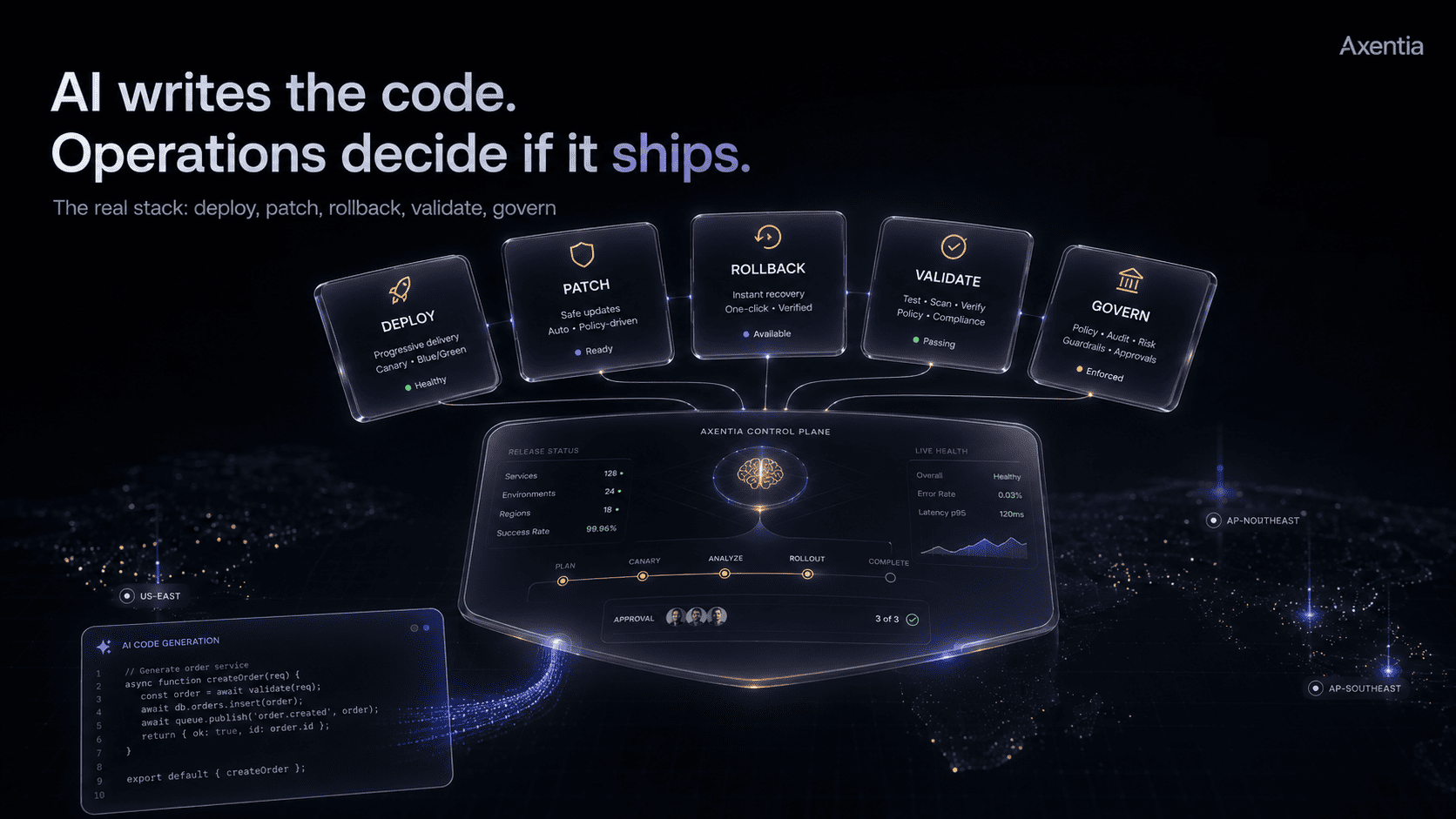
Generating code is the easy part now. Deploying it, patching it, rolling it back when something breaks, and making sure it does not take down production for a customer in Frankfurt at 2 AM is the hard part. That gap is what Palantir is trying to close with its newly announced expansion of Apollo, positioned as the operational layer that sits above AI code generation.
The pitch is straightforward. AI can write software faster than any team in history. What it still cannot do is decide when that software is safe to ship, where it should run, who needs to approve it, and what to do when it starts misbehaving. Palantir calls these the ontology primitives of software distribution: deploy, patch, rollback, validate, govern. Five verbs that every production system already handles in some ad hoc way, now packaged as a controlled, repeatable layer.
The deployment problem AI made worse
If you have ever shipped a product, you know the shape of this problem. A junior engineer pushes a fix. The CI pipeline goes green. The change lands in production. Two hours later a customer reports that exports are broken in three countries. Now multiply that by AI agents writing pull requests at machine speed, and you have the operational reality teams are walking into.
Apollo's architecture
The promo walks through the pieces. A catalog and manifest layer tracks what exists across the estate. An orchestration engine decides what moves where. Adjudication and canary stages catch problems before full rollout. A spoke control plane handles distributed environments. Observability watches the whole thing. None of these ideas are new individually. The bet is that connecting them under one ontology, with AI handling the routine middle and humans making the consequential calls, becomes the default way serious software gets shipped.
Defense origins
Apollo did not start as a developer tool. It started as the platform Palantir uses to deploy autonomous systems into defense settings, where rolling back a bad update is not a Slack apology but an actual operational risk. That heritage shapes the philosophy. Speed matters, accountability matters more. AI accelerates the work, humans own the outcome.
For founders and operators outside defense, the lesson translates cleanly. The next wave of competitive advantage is not who can generate code fastest. It is who can ship AI generated code into production with confidence, governance, and the ability to undo a mistake before it compounds.
What changes for everyone else building
Treat deployment as a first class product surface, not an afterthought. The teams winning over the next two years will be the ones who instrument every release like a controlled experiment, with a clear rollback path and a clear owner.
The verbs Palantir chose are the right ones to organize your own thinking. Deploy, patch, rollback, validate, govern. If you cannot answer how each of those works in your stack today, that is the homework.
Blind pipelines are a liability dressed up as a feature. Speed without accountability is just a faster way to fail at scale. The interesting question is where humans belong in the loop, and what they need to make a good call when something goes sideways.
Palantir is making a specific bet about how that future gets built. Whether or not Apollo wins the category, the category itself is now real.
Building an AI product and want help thinking past the code generation step? Axentia builds AI products with the deployment, governance, and rollback discipline production actually demands. Start a conversation at axentia.in.