
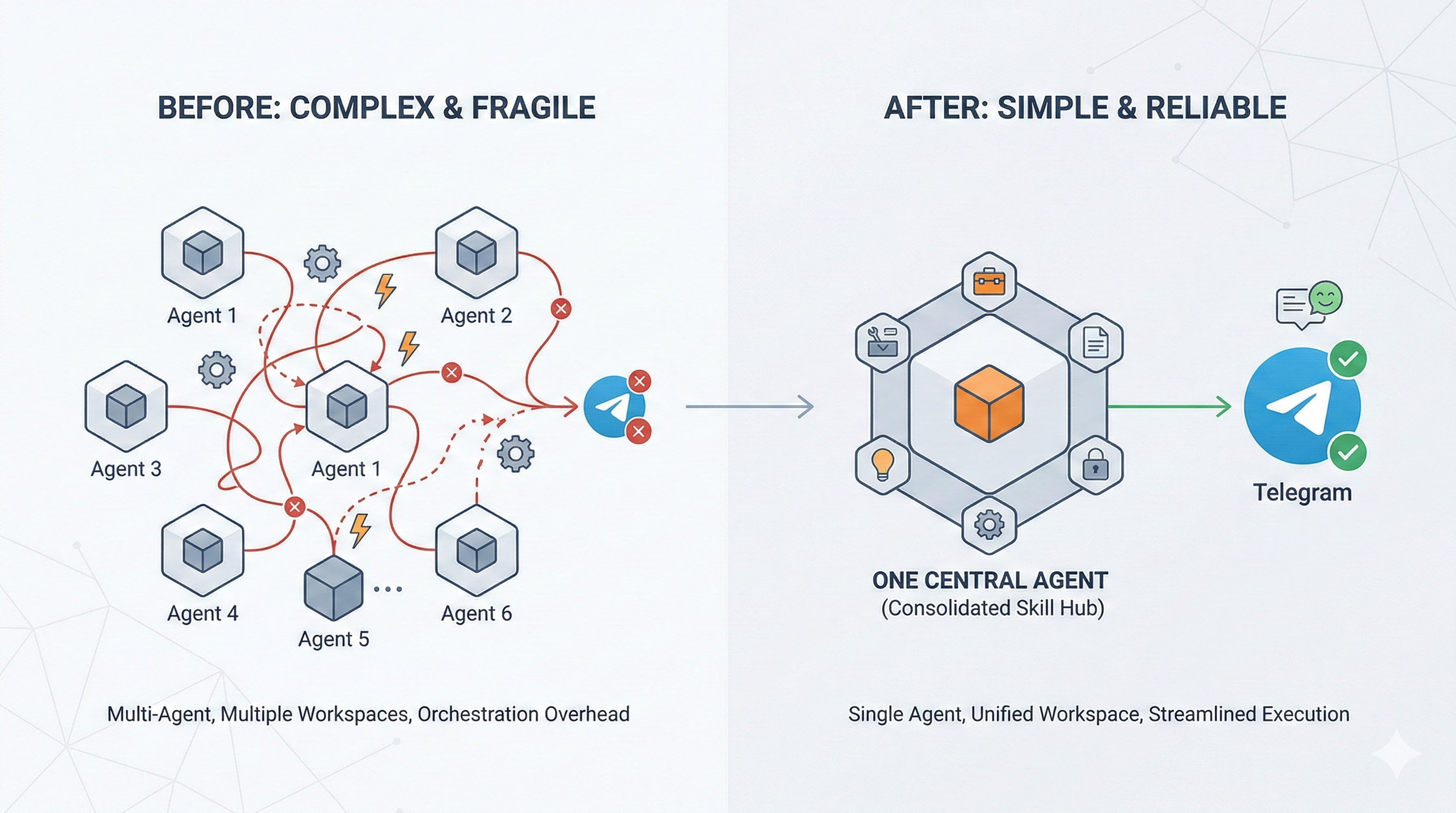
The Architecture We Started With
When we started building AI-driven workflows, we followed what most teams consider best practice:
We chose a multi-agent architecture.
On paper, it sounded ideal: multiple specialized agents, separate workspaces, clearly defined roles. A structured AI “team” collaborating behind the scenes.
It felt like the right way to build.
But production had other plans.
Where Things Started Breaking
We implemented the structure outlined in the OpenClaw documentation. Architecturally, everything looked elegant.
Then we moved into real-world usage.
Our primary interface was Telegram. All outputs and executed documents were expected to arrive there.
Instead, we experienced:
- Documents not arriving
- Context loss between agents
- Timeouts during agent hand-offs
- Random delivery failures
Each agent lived in its own workspace. Every task required transitions between environments.
And every transition introduced friction.
Eventually, we had to admit something uncomfortable:
We weren’t building workflows anymore.
We were debugging orchestration.
The Architectural Breaking Point
The realization was simple:
We didn’t need an army of agents.
We needed one reliable execution system capable of handling multiple roles internally.
So we made the shift.
Instead of distributing skills across separate agents and workspaces, we built:
- One unified workspace
- One centralized agent
- One consolidated skill hub
- Zero fragile hand-offs
The impact was immediate.
What Changed
1. Performance Improved Instantly
In a multi-agent system, every hand-off introduces latency:
Agent A finishes → passes context → Agent B processes → passes again.
With a single agent:
- No transitions
- No external context passing
- No orchestration overhead
The agent receives the objective, executes internally, and delivers directly to Telegram.
The system became:
- Faster
- Cleaner
- Predictable
2. Decision Fatigue Disappeared
Previously, every request triggered architectural questions:
- Which agent handles this?
- Is it in the correct workspace?
- Does it have permissions?
- Will it require another agent?
Now?
We provide the objective.
The system determines execution internally.
Operational complexity dropped overnight.
3. Security Became Simpler (Not Weaker)
Multi-agent systems are often praised for isolation.
In theory, separation increases security.
In practice, managing policies across multiple agents introduced configuration complexity and inconsistency.
With a centralized architecture, we now control:
- Skill-level access
- Directory permissions
- Output channels
- Execution rules
Instead of managing ten policy surfaces, we manage one controlled environment.
Security didn’t degrade.
It became easier to reason about and audit.
Results After Simplification
After consolidating to a single-agent architecture:
- Delivery failures stopped
- Telegram outputs became reliable
- Response times improved
- Debugging efforts dropped significantly
Operational stability improved more from simplification than from added sophistication.
What We Learned
Multi-agent architecture is powerful.
For distributed, large-scale systems, it absolutely makes sense.
But for our specific workflow and delivery model, it introduced more overhead than value.
Complexity often feels like progress.
But sometimes, removing moving parts is the real optimization.
Final Thought
If you’re facing:
- Fragile hand-offs
- Slow execution cycles
- Workspace confusion
- Delivery bottlenecks
You might not need more agents.
You might need fewer.
For us, clarity didn’t come from adding sophistication.
It came from removing unnecessary complexity.
And that made all the difference.