
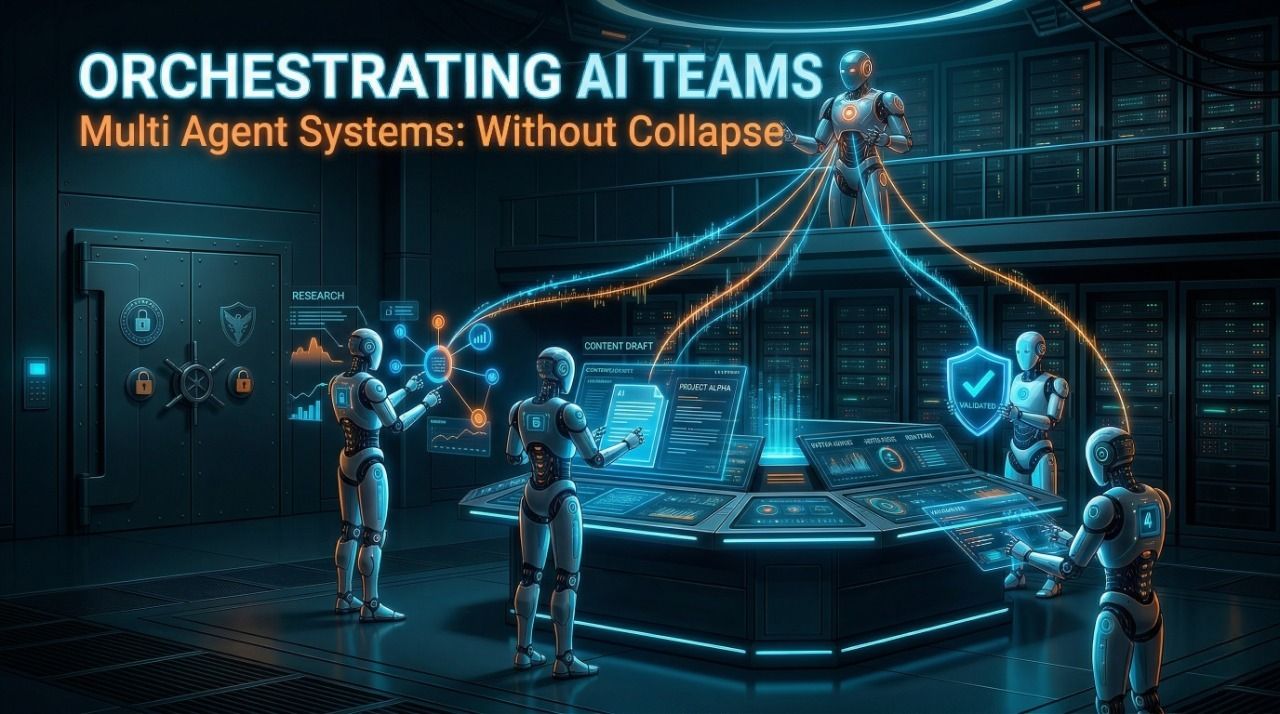
The sales team finally got their dream: five specialized agents handling the entire lead-to-close process. One qualified prospects from LinkedIn. Another wrote personalized emails. A third scheduled calls. A fourth checked compliance. The fifth closed the deal in the CRM.
It worked beautifully… for three days. Then the compliance agent flagged a harmless email as risky. The scheduler looped endlessly waiting for approval. The closer kept sending contracts to the wrong contact. Total cost: one lost deal, two frustrated reps, and a very awkward retro meeting.
This isn’t a hypothetical. It’s the pattern repeating across enterprises in early 2026. Single agents feel magical in demos. Teams of agents feel like herding cats once they hit real workloads.
Gartner named multi-agent systems one of the headline strategic technology trends for 2026. The promise is clear: break complex work into specialized roles, let agents collaborate, and unlock automation that actually scales. The reality is messier. Coordination overhead explodes. Errors cascade. Visibility disappears. Many pilots quietly die before reaching production.
The difference between hype and value comes down to orchestration. Done right, a team of agents becomes a reliable digital workforce. Done wrong, it becomes expensive noise.
Defining Clear Roles That Actually Work
Most collapse starts with fuzzy responsibilities.
Before: “Research agent: find information about the prospect.” The agent returns 40-page web scrapes, outdated financials, and three contradictory LinkedIn profiles. The email agent then hallucinates a pitch based on bad data.
After: “Research agent: return company name, employee count, funding round, last funding date, and one-sentence recent trigger event. Source must be from the last 90 days. Output strict JSON only.”
Specialization beats generality every time. Narrow roles reduce hallucination surface and make handoffs predictable.
Practical checklist for role definition:
- Give each agent a single primary responsibility and explicit output schema.
- Define success criteria and failure signals in advance.
- Specify exactly which tools and data sources the agent may use.
- Set clear escalation paths when confidence drops below a threshold.
Teams that treat role definition like API contracts see dramatically fewer cross-agent misunderstandings.
Building Reliable Communication and Handoffs
Agents need to talk without stepping on each other.
Common failure mode: Agent A passes half-finished work to Agent B. Agent B misinterprets context and compounds the error. The loop continues until someone notices the output is garbage.
Before example (simplified schema):
{
      "lead_data": "raw scrape results",
      "next_action": "send email"
}
```json

After example (structured handoff):

```json
{
   "lead_id": "lead_8392",
   "qualification_score": 87,
   "key_trigger": "raised Series B last month",
   "recommended_tone": "professional growth-focused",
   "compliance_flags": [],
   "handover_confidence": 0.92
}
Add a lightweight supervisor or router agent that only decides routing and quality gates. It doesn’t do the work. It keeps the team aligned. This mirrors how engineering teams use tech leads rather than letting every developer decide architecture on the fly.
Include shared memory patterns (persistent context store) so agents don’t re-explain the same facts. Without it, you’ll watch the same research repeated six times in one workflow.
Testing and Monitoring Like Production Software
Treat the entire multi-agent system as a distributed application.
Individual agent tests pass easily. The moment you chain them, new failure modes appear: race conditions, conflicting updates, token exhaustion, and silent loops.
Checklist that actually catches problems early:
- Unit test each agent in isolation with fixed inputs.
- Integration test full workflows with realistic data variations.
- Add chaos testing: randomly delay or fail one agent and verify graceful recovery.
- Instrument every handoff with timestamps, confidence scores, and token usage.
- Set hard cost and latency budgets per workflow. Alert when breached.
One team I worked with discovered their “simple” five-agent sales workflow was burning 40% more tokens than budgeted because the researcher kept calling the same API twice. Visibility fixed it in an afternoon.
Governance, Security, and Human Oversight
Autonomous doesn’t mean unsupervised.
In 2026, identity and access management for agents is becoming table stakes. Each agent needs its own scoped credentials, audit trail, and revocation path. Never give the full team broad permissions.
Build in human-in-the-loop gates for high-stakes actions. The system should escalate naturally rather than fail silently or proceed dangerously.
Version your agent definitions and orchestration logic the same way you version code. Rolling back a bad agent update should take minutes, not days of debugging.
Real-World Outcome
A mid-sized SaaS company moved from scattered single-agent experiments to a governed four-agent customer onboarding team. They defined strict schemas, added a router agent, and instrumented every step.
Results after eight weeks:
- Onboarding cycle time dropped 62%
- Manual handoffs between teams fell from 11 to 2 per customer
- Compliance audit trail became automatic
- Total agent-related cost stayed under budget because inefficient loops were caught early
The agents didn’t replace people. They removed the boring, repetitive friction that slowed everyone down.
Multi-agent systems are no longer experimental. They are becoming the default way serious automation gets done in 2026. The teams winning aren’t the ones with the smartest individual agents. They’re the ones who treat orchestration as serious engineering work.
If your pilots keep collapsing under their own coordination weight, the fix usually isn’t a bigger model. It’s tighter roles, structured handoffs, proper monitoring, and deliberate governance.
We help engineering teams move from fragile agent experiments to reliable, sovereign multi-agent systems that run securely on their own infrastructure. If you’re tired of promising demos that never survive real traffic, drop us a note. A 15-minute architecture review often surfaces the exact coordination gaps holding you back.
The era of lone-wolf agents is ending. Well-orchestrated teams are just getting started.