
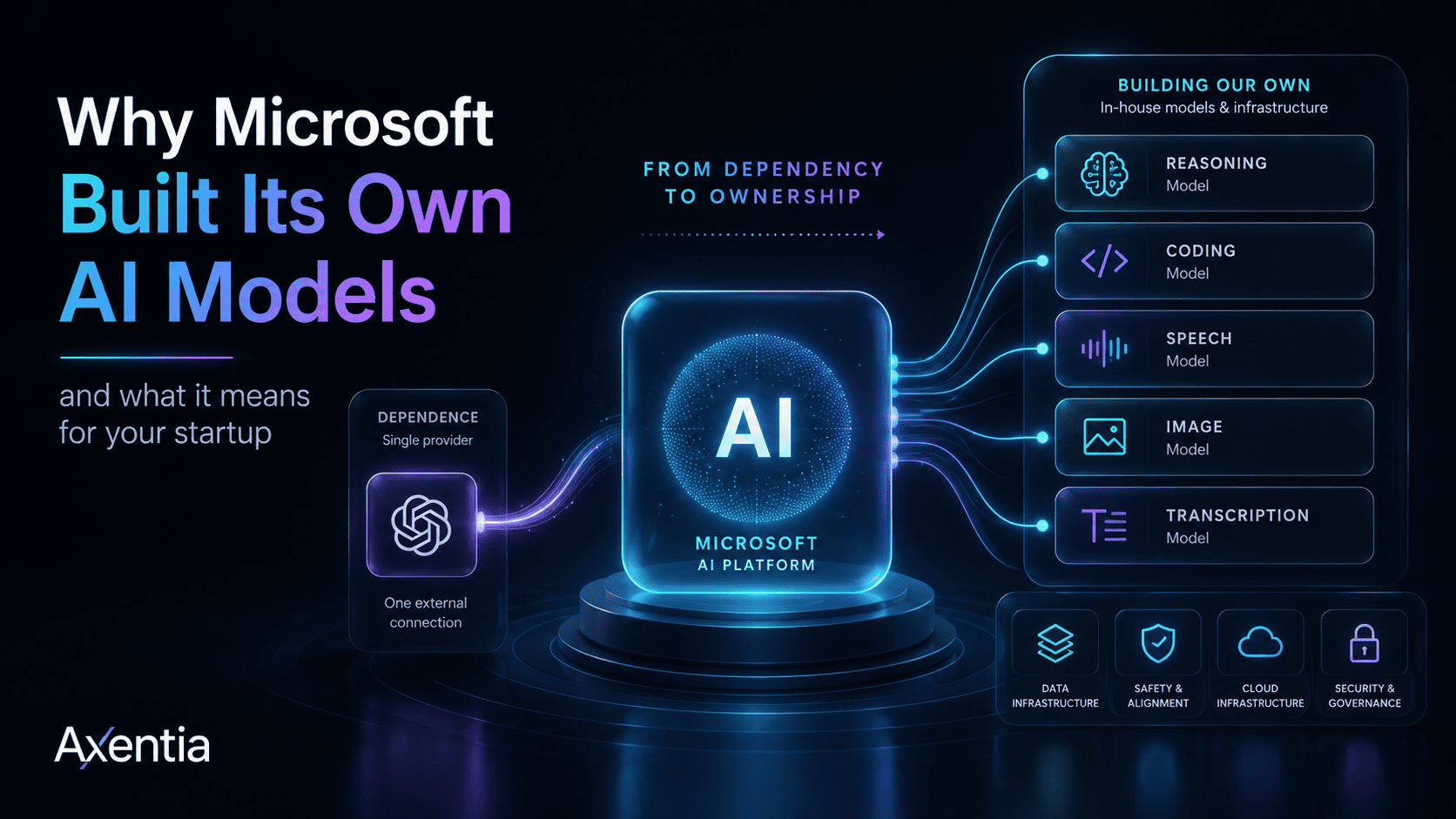
At its Build conference on June 2, Microsoft unveiled seven AI models it built in-house, grouped under the name MAI. For a company that poured more than 13 billion dollars into OpenAI and built much of its AI strategy around that partnership, that is a striking move. Microsoft is now training its own frontier models and openly calling the goal long-term self-sufficiency.
The models are capable. The more useful story for founders is why a 3 trillion dollar company decided it could no longer afford to depend on a single AI provider, and what that should tell you about your own product.
What Microsoft actually shipped
The lead model, MAI-Thinking-1, is Microsoft's first reasoning model, built from scratch on licensed data with no borrowing from other companies' models. In blind tests it was preferred over Claude Sonnet 4.6 and matched Claude Opus 4.6 on a standard coding benchmark. There is also MAI-Code-1-Flash, a small 5 billion parameter coding model now rolling out across GitHub Copilot, along with new models for images, speech, and transcription.
Alongside the launch, Microsoft reworked its OpenAI deal. It capped the revenue it shares with OpenAI and gave up its exclusive right to resell OpenAI's models. The partnership still runs through 2030, but the direction is unmistakable. Microsoft wants its own models running underneath its own products.
The dependency problem
Here is the part that matters for founders. Microsoft was the largest backer OpenAI ever had. If even Microsoft concluded that leaning on one model provider was too risky, that logic applies to your startup with far more force.
When your product is wired to a single AI vendor, you inherit every move that vendor makes. A price increase lands straight on your margins. A model gets retired and your carefully tuned prompts quietly break. Rate limits tighten during your busiest week. Terms shift and a feature you shipped becomes off-limits. None of these are hypothetical. They have all hit teams over the past year who assumed the provider they started with would stay cheap, available, and predictable.
What founders should do
You do not need seven in-house models. You need a thin layer between your product and whichever model powers it. Route your AI calls through one internal interface so swapping providers becomes a config change instead of a rewrite. Keep a tested fallback model ready for your core features. Track pricing and deprecation notices the way you track your cloud bill.
None of this means the frontier labs are doing bad work. They are shipping extraordinary models. The point is simpler: the survival of your product should not hinge on a decision made in someone else's boardroom.
Microsoft spent years and billions learning this at enterprise scale. You can learn it for the cost of a little architecture discipline now, before a pricing email forces the question for you.
At Axentia we build AI products with that flexibility designed in from the start, so a model change is a quiet afternoon and not a fire drill. If you are not sure how exposed your product is to a single provider, that is a good place to begin.