
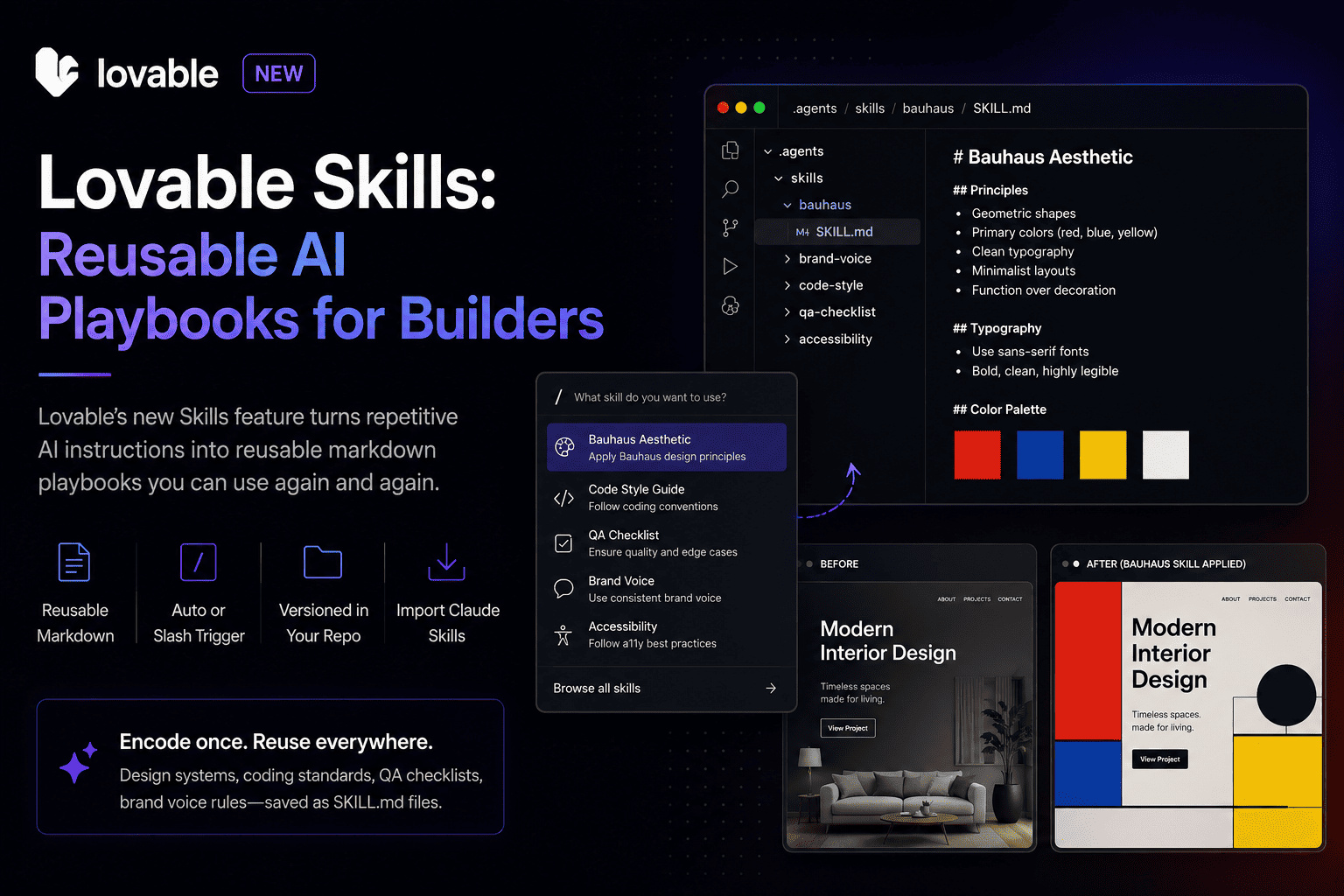
Lovable just shipped Skills, and it is worth paying attention to.
Skills are reusable AI instructions saved as markdown files. Lovable can apply them automatically when a task looks relevant, or you can trigger them manually with a slash command. Think design systems, coding conventions, QA checklists, brand voice rules, launch checklists, accessibility standards, and product-specific preferences.
Basically, anything you would otherwise paste into a prompt fifteen times a week.
That sounds simple, but it solves a real problem in AI-assisted product building. The model may be powerful, but the output is only as consistent as the context it receives. One day it follows your design direction. The next day it forgets your spacing rules. One builder gets clean, structured code. Another gets something that technically works, but ignores your standards.
Skills are Lovable's way of turning repeated instructions into reusable product memory.
What's Actually in the Box
The mechanics are clean.
You prompt Lovable to create a skill, for example, "apply Bauhaus aesthetics to designs." Lovable drafts a SKILL.md file, you review and edit it, and it lives inside your project at:
.agents/skills/[skill-name]/SKILL.md
Five skills ship pre-built. You can also write your own. More importantly, you can import Claude skills as zip files. That matters because portability across AI tools is still rare. Most AI workflows today are trapped inside one platform, one project, one chat, or one builder's memory.
The demo Lovable led with was a Bauhaus transformation. A clean minimalist interior design site goes in. A geometric red, blue, and yellow modernist site comes out. Typography, layout, color, spacing, and visual rhythm are rewired while the core content stays intact.
The important part is not the Bauhaus style itself. It is the repeatability. The skill encoded the aesthetic rules so the model did not have to guess them again every turn.
Why This Matters Beyond the Demo
Lovable is positioning itself for serious iterative work, not just one-shot vibe coding. Skills are the unlock for that.
If you are a solo builder, Skills reduce the prompt-paste tax. You no longer need to repeatedly explain your design taste, code style, QA process, or product preferences. You can define the rules once, refine them over time, and reuse them whenever needed.
If you are working in a team, the value is even clearer. Skills become a way to encode standards so AI output stays consistent across builders, projects, and time. This is especially useful when multiple people are using the same AI builder but bringing different levels of taste, technical judgment, or product context.
This is the same logic behind design tokens, ESLint configs, PR templates, and internal operating docs. Good teams do not rely only on memory. They turn repeatable judgment into systems.
The interesting part is the format. Markdown skills are diffable, versionable, and shareable. They can sit inside your repo like any other config. A skill that captures brand voice can be reviewed in a PR. A skill that enforces coding conventions can improve after every bug. A skill for QA can evolve as the product matures.
That is the bigger signal here.
The next phase of AI product building will not just be about better models. It will be about better operating systems around those models. Lovable Skills is a small feature, but it points in that direction.