
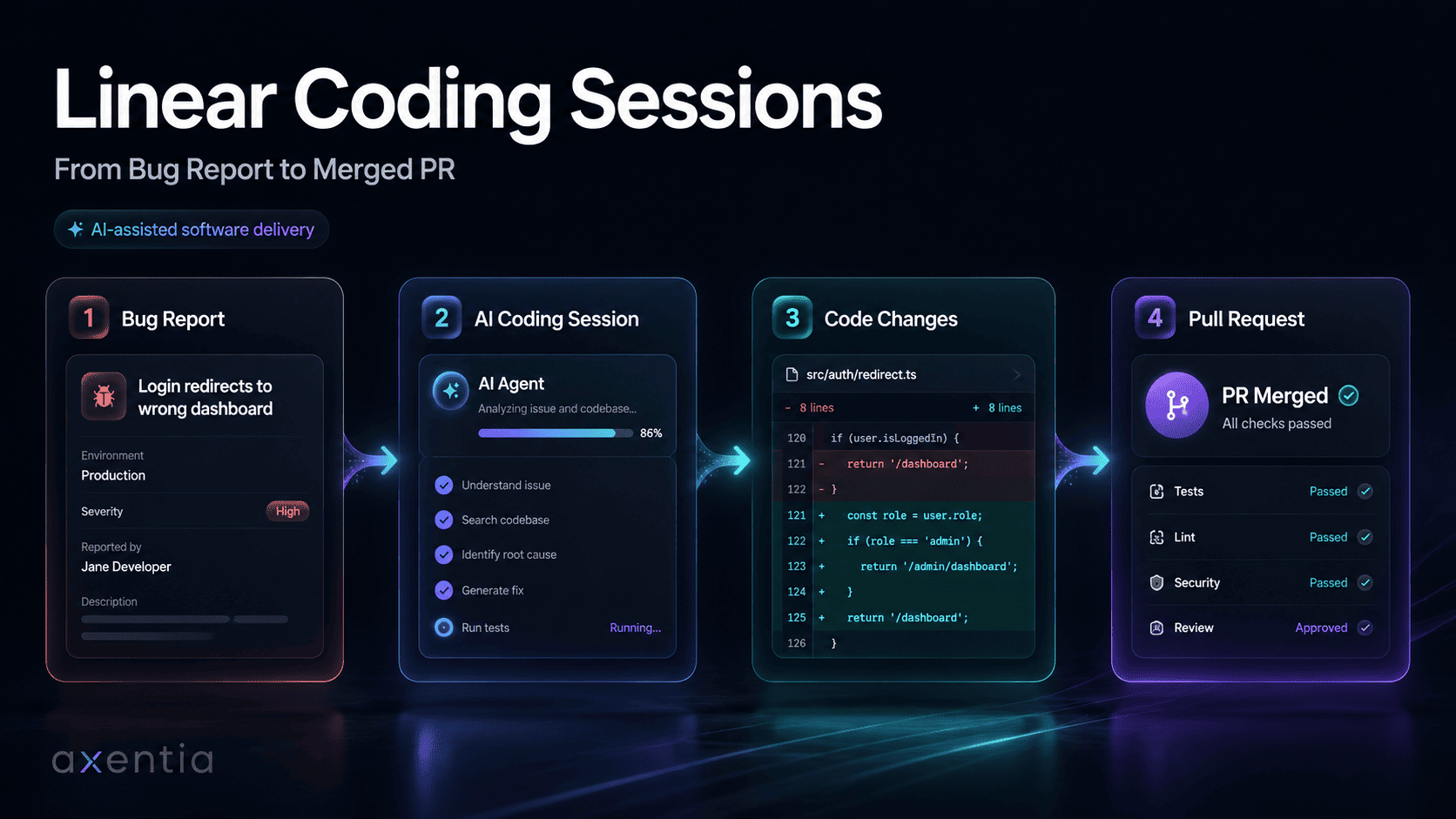
A bug lands in your tracker. Someone reads it, copies the details into a separate coding tool, spins up a branch, writes the fix, opens a pull request, then walks back to the tracker to close the loop. Every handoff loses a little context, and every step needs a human standing over it. For a small team, that friction is the difference between shipping a fix now and shipping it three days from now.
Linear has removed most of that friction. With coding sessions, Linear Agent can write code directly, using Claude Code and Codex, without the work ever leaving the place where it was reported.
What actually happens
You delegate an issue to the agent, or ask it to fix something from a chat, a comment, or a Slack or Teams thread. From there, the agent reads the issue and the discussion around it, investigates your codebase with Code Intelligence, proposes an approach, writes the code, and opens a pull request. It can also reach into tools like Sentry or Datadog through MCP to triangulate what is actually breaking before it touches a line.
The whole thing runs in a secure cloud sandbox. No local setup, no branch to babysit. When the work is ready, Linear returns a diff you can review right beside the original issue, in the same context the agent worked from.
Built for teams, not the person who started it
This is the part that matters for how a team operates day to day. A coding session is shared. Anyone can follow the work, add context, redirect the approach, request changes, or take over entirely. The session belongs to the organisation rather than to whoever kicked it off, so the work survives someone going offline, and the trail from first report to merged change stays in one place.
You can take it further with triage automation. Instead of waiting for a person to pick up a new issue, you can set the agent to grab it the moment it lands in triage, investigate, and attempt a fix before anyone touches a keyboard. Linear reports using this exact workflow internally to resolve roughly 30% of its incoming bug reports, mostly on the first pass.
What it costs and how to turn it on
Coding sessions are available on Basic, Business, and Enterprise plans. You need a GitHub connection with code access, and the sessions run on AI credits, so usage has a real meter attached. The default model under Auto is Claude Opus 4.8, with Claude Fable 5, Sonnet 4.6, GPT-5.5, and GPT-5.4 also selectable.
Where the time savings show up
If you are a founder running lean, the promise here is straightforward. Routine bugs and small changes can move from report to reviewable PR without pulling an engineer out of deep work. Your team's judgment goes where it is worth the most: reviewing the diff, steering the approach, deciding what ships. The boring middle steps get handled.
The honest caveat is the credit meter. This is metered automation, not a free lunch, and on a busy board the costs compound, so it pays to scope which issues get delegated while you learn what the agent handles well. Used deliberately, coding sessions close a gap that has quietly cost small teams hours every week.
Tools like this lower the cost of shipping. They do not decide what to ship, how to architect it, or where AI actually earns its place in your product. That part still takes judgment, and it is where most teams get stuck.
That is what Axentia does. We are a generative AI and LLM product studio that helps founders go from idea to working software, whether that means building an MVP, layering AI features into a product you already run, or wiring agentic tooling into how your team works. If you are trying to figure out where automation like this fits your stack, book a consultation with Axentia and we will map it out with you.