
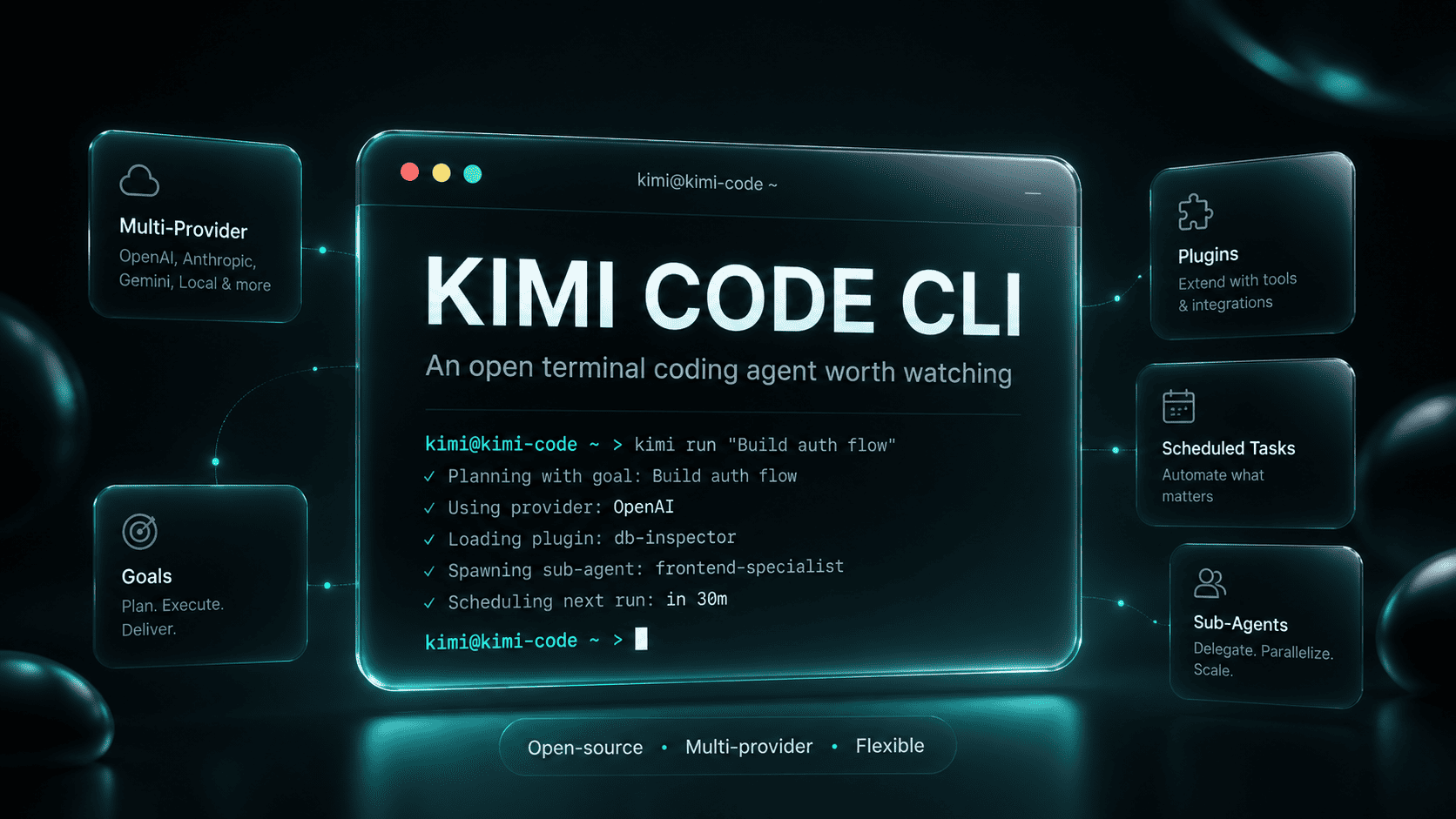
Moonshot AI quietly rebuilt its terminal coding agent from the ground up, and the result is one of the more interesting open tools in the space.
Here is what Kimi Code actually is, and where it earns a place in a studio's toolkit.
What Kimi Code actually is
Kimi Code is an open-source coding agent that runs in your terminal. It reads and edits code, runs shell commands, searches the web, and plans multi-step work on its own, the same loop you know from Claude Code or Gemini CLI.
It ships in three forms: a CLI, a VS Code extension, and an ACP service that plugs into editors like Zed and JetBrains.
The version 0.1.0 release marked a full rewrite from Python and uv to Node.js and TypeScript. That is more than housekeeping. It brought a one-line install with no Python dependency, faster startup, a proper terminal UI with a status bar and approval panel, and built-in sub-agents for coding, exploration, and planning.
The legacy Python kimi-cli is being wound down in its favor.
Why the open, multi-provider design matters
The detail that stands out for a studio is provider flexibility.
Kimi Code works out of the box with Moonshot's open-weights Kimi models, but it also speaks to Anthropic, OpenAI, Gemini, Vertex, and other compatible endpoints. You configure providers through a /provider panel or environment variables, then route a task to whichever model fits the budget and the job.
That matters in two situations we hit often.
The first is cost-sensitive client work, where an open model at a fraction of frontier pricing changes the economics of long agent runs. The second is clients with data-residency or vendor-independence requirements, where pointing the same agent at a different backend is a real advantage.
The features shipped so far
The release cadence has been fast, roughly a version a week. These are the additions worth knowing:
- Goals. Hand the agent an objective with
/goaland it works across turns until done or until it needs a decision. A goal queue lets you line up tasks to run in sequence. - Background questions. When the agent needs input, it parks the question and keeps working instead of blocking on a single choice.
- Scheduled tasks. Natural-language reminders and recurring cron-style runs.
- Plugins. Install packages of skills and MCP servers, including straight from a GitHub URL, with a trust label on each.
- Sub-skill discovery. A new experimental system to audit and consolidate skills, currently gated behind a flag.
The honest caveats
This is a sub-1.0 tool moving quickly. Features churn, several sit behind experimental flags, and bugs get fixed release to release.
Treat it as a capable secondary agent for evaluation and specific jobs, not a drop-in replacement for whatever runs your production work.
For us at Axentia, the value is knowing the landscape. We build on the model that fits each engagement, and an open, provider-agnostic agent widens that menu.
Kimi Code is worth a serious afternoon of testing if you run agent workflows and care about cost and flexibility. Pull it down, point it at a real repo, and watch it handle a multi-file task before you trust it with anything that matters.