

TypeSafe released Jev on September 15, 2026, and it is not another chatbot. Jev gives up text generation so it can make typed decisions for software in a fraction of a second.
That trade is more interesting than it first sounds. Most production AI workflows do not need a paragraph at every step. They need an answer to a narrow question: Which queue gets this ticket? Is this action risky? Does this invoice need review? Jev is designed to answer those questions directly, with a probability your code can use.
The launch numbers are dramatic. TypeSafe prices input at $0.042 per million tokens, does not charge for output, and reports 70 to 500 millisecond response times. The company also advertises workload-specific gains as high as 193.6 times faster and 444.6 times cheaper than its language-model baselines.
Those are vendor results from workflows shaped for Jev, not a universal law of AI economics. The more important story is the architecture it encourages: keep control in code, and let the model supply only the fuzzy judgments.
What is Jev AI?
Jev is TypeSafe's first "System One" model, a company term inspired by the fast, intuitive mode of thinking described in Daniel Kahneman's Thinking, Fast and Slow. TypeSafe founder Diogo Almeida previously coauthored the InstructGPT paper, research that helped make instruction-following chat models practical.
Instead of generating tokens one after another, Jev receives two inputs:
-
State: The relevant text or structured data, such as a customer conversation, account record, or agent trace.
-
Typed questions: The specific judgments the application needs from that state.
According to the TypeSafe documentation, Jev supports three question types, which it calls primitives:
| Question type | What it asks | What comes back |
|---|---|---|
Noul | Is this statement true? | A probability from 0 to 1 |
Choice | Which defined option fits best? | A selected option, probability distribution, and confidence |
Score | Where does this fall on a scale? | A score, probability distribution, and confidence |
Multiple questions can be evaluated against the same state in parallel. TypeSafe's System One documentation describes these as independent questions asked together. That matters when one support conversation needs 15 judgments, because the model can share the state without generating 15 separate explanations.
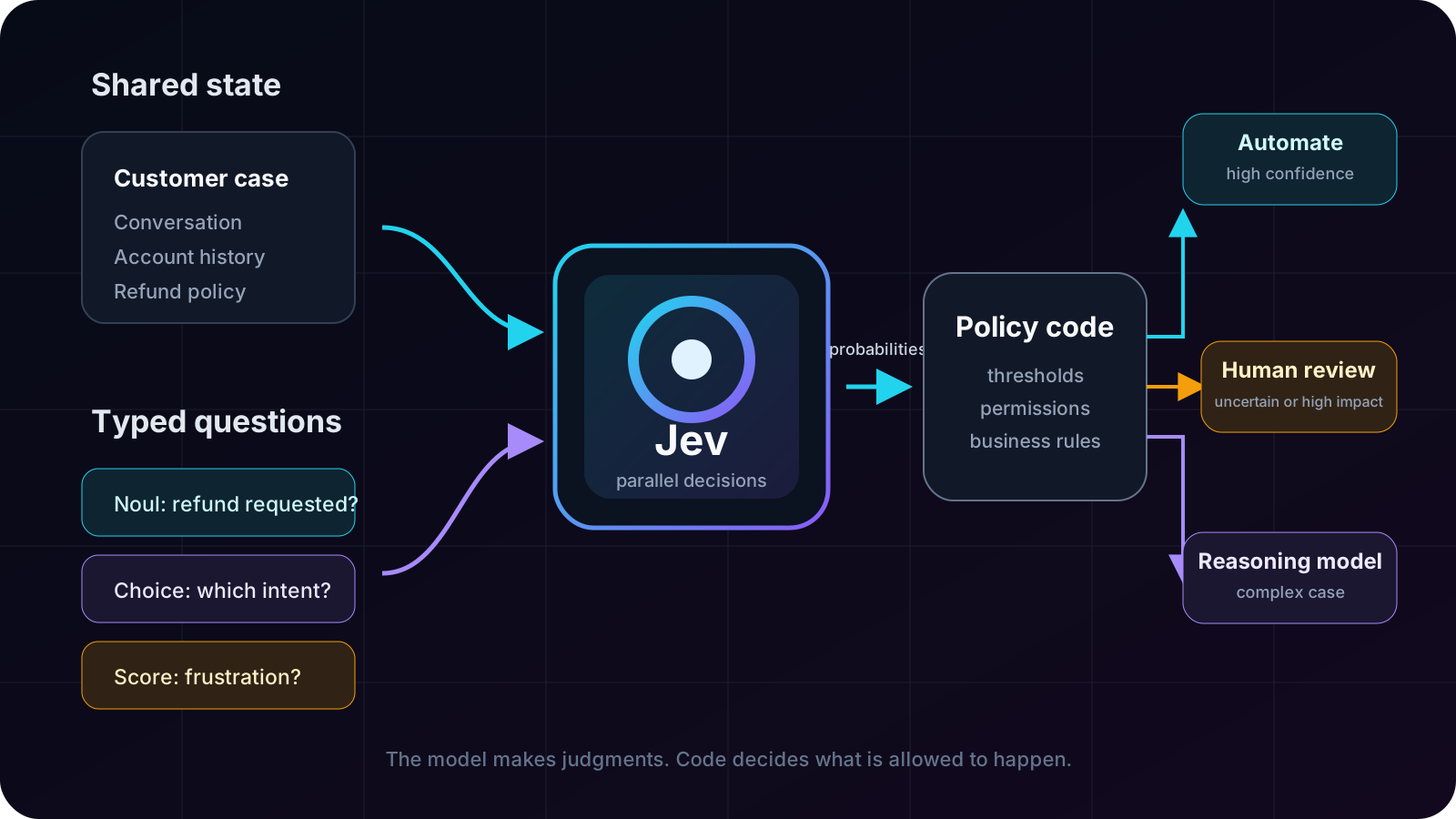
Jev makes the fuzzy judgments. Deterministic policy code still controls thresholds, permissions, and side effects.
The real improvement is the code boundary
Language models can already return JSON and call tools. The difference is that general LLMs are still text generators being constrained into a schema. Jev is built around the schema itself.
That makes invalid output types much harder to produce. If a Choice allows billing, technical, and sales, Jev cannot invent a fourth label or wrap the answer in a friendly essay. Your application receives one of the declared values and its probability distribution.
But "type safe" does not mean "always correct." Jev can return billing in exactly the right format when technical was the right answer. TypeSafe's launch post sometimes frames the model as unable to hallucinate, but the defensible interpretation is narrower: the output cannot violate the declared type. Semantic errors, false positives, bias, and overconfidence are still possible.
That distinction matters in production. A parser failure is visible. A valid but wrong decision may quietly send a refund, security alert, or invoice down the wrong path.
Jev is trained with a method TypeSafe calls Reinforcement Learning for Calibrated Decisions, or RLCD. The goal is for predicted probabilities to track real outcomes across groups of decisions. If the model assigns 0.9 to many comparable cases, roughly 90 percent of them should be correct.
That is a training objective, not a guarantee about one answer. Calibration still has to be measured on your traffic, especially after the input distribution changes.
Jev's speed and pricing need context
TypeSafe reports end-to-end latency between 70 and 500 milliseconds and a price of $42 per billion input tokens. Output is free because the response is a small set of values rather than a generated passage. The company says its largest speed and cost multipliers come from four internal workflows covering security incidents, agent trace review, invoices, and customer service.
The workflow evaluation methodology is useful, but it is not a conventional ground-truth benchmark. TypeSafe decomposed each task into a decision graph, then compared model outputs with consensus labels generated by GPT-6 Astra and Claude Fable 5.1. TypeSafe also notes that its own capabilities team created the workflows and that the headline 193.6 times speed and 444.6 times cost gains sit near the high end of what it expects in practice.
In other words, the benchmark supports a specific claim: when many narrow judgments share the same state, Jev can occupy a compelling latency and cost position. It does not prove that Jev is more accurate than a frontier model, calibrated on your data, or cheaper than a small specialist classifier.
An early external test adds useful evidence. Every's Mike Taylor asked Jev 21 questions across 37 documents. It returned 777 judgments in under 0.7 seconds for an estimated quarter of a cent. In a smaller comparison, Jev found six of seven deliberately planted writing problems while Fable 5.1 found all seven. Jev was about 25 times faster and an estimated 580 times cheaper in that test, but it also missed a defect that the larger model caught. Every's full experiment is a better reason to test Jev than any perfect-looking launch chart: the quality tradeoff is visible.
Where Jev could change an AI product
The strongest use case is not replacing every LLM call. It is removing expensive generation from the small decisions surrounding those calls.
The obvious candidates are the small judgments that surround a more expensive model call:
-
An agent checks whether it found the right context, whether a proposed action looks risky, or whether its draft violates a known requirement.
-
A support system classifies intent, urgency, and frustration before code chooses a queue.
-
A retrieval pipeline scores candidate documents before a larger model reads the best few.
TypeSafe's stranger demos are useful because they expose the latency envelope. Its Doom bot makes around 10 decisions per second for roughly $7 per hour, although it reads structured game state rather than images and TypeSafe admits a conventional bot could play better. Its Wikipedia racing demo selects among hundreds of links at each step, showing why constrained choices matter when one invented option can derail the entire run.
Those demos are not business cases. They demonstrate that a semantic judgment can sit inside a tight software loop instead of blocking it for several seconds.

Confidence is useful when it changes the route. High-confidence, low-risk cases can proceed automatically. Everything else needs an explicit fallback.
The pattern becomes especially useful at high volume:
- Jev makes several cheap judgments.
- Code handles obvious, low-risk cases.
- Uncertain or high-impact cases go to a person or a more capable model.
- The system records the result so thresholds can be evaluated against reality.
That last step is not optional. A confidence value only earns trust when you test it against labeled outcomes from your own workload. If cases scored at 0.9 are not correct roughly 90 percent of the time, the number is decoration.
Where Jev is the wrong tool
Jev cannot write the customer reply, explain a security incident, generate code, or build an open-ended plan. If the workflow needs prose, you still need templates or a generative model.
It is also a weak fit when a deterministic rule already works. Do not call a model to check whether an invoice total exceeds a fixed limit. Compute that in code. Jev belongs where the input is messy and the judgment is semantic.
For stable classification tasks with enough labeled data, a conventional classifier or reranker may be cheaper, easier to audit, and available to run on your own infrastructure. Jev launched in early access with closed weights, and TypeSafe has not publicly detailed the model size, training data, service-level agreement, rate limits, or production latency percentiles.
High-stakes decisions need another layer of caution. A typed probability is a good interface for a safety gate, but it is not permission to remove human review before Jev has been evaluated on the exact failures that matter.
What builders should test this week
Pick one repeated decision that currently consumes an LLM call. Ticket routing, retrieval scoring, agent-output review, and escalation detection are good candidates.
Build a labeled set from real cases, then compare Jev with the system you already use. Measure:
-
Decision accuracy against labels your team trusts
-
Calibration of the confidence scores
-
p50 and p95 end-to-end latency
-
Cost per successful decision, including fallbacks
-
Operational cost of false positives and false negatives
Do not tune a threshold on the same examples used to report the result.
If Jev wins, keep the first deployment narrow. Let code own the rules. Escalate low-confidence cases. Pin a model version where reproducibility matters. Preserve the larger model for the work that actually needs language.
Jev's most useful idea is not that every AI system should stop generating text. It is that most software asks models to generate far more text than the decision requires.