
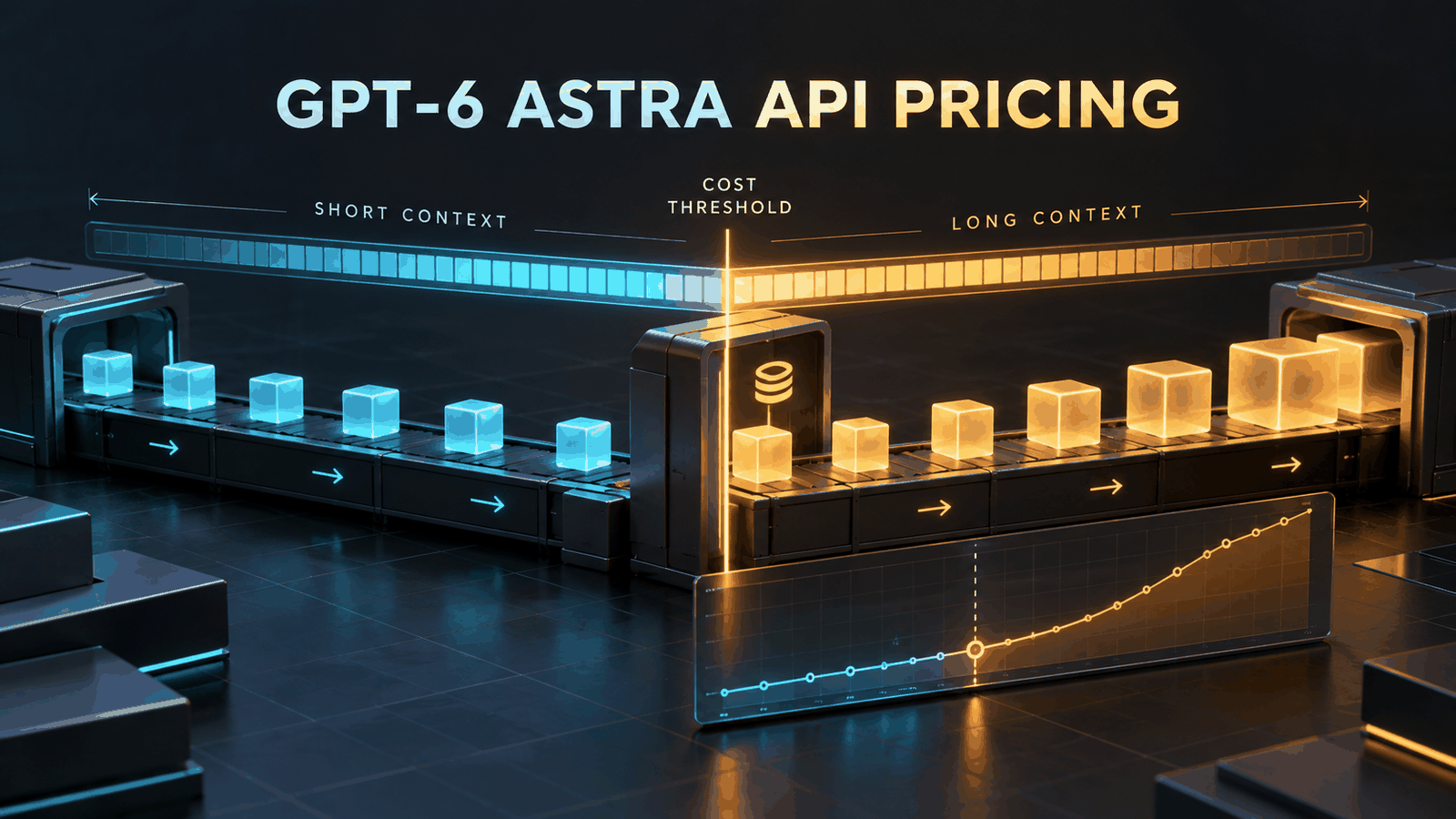
The gpt-6-astra API applies long-context pricing once a request exceeds 272,000 input tokens. Cross that GPT-6 Astra 272K token limit by one token and the higher rates apply to the entire request, not only the excess. At Standard rates, input doubles from $10 to $20 per million tokens and output rises from $50 to $75 per million.
Our answer is direct: do not treat Astra's 1.05 million-token window as a substitute for retrieval. Add a token gate before the API call, then route oversized prompts through retrieval, summarization, or an explicitly approved long-context path.
What the GPT-6 Astra 272K token limit changes
OpenAI lists a 1,050,000-token context window and 128,000 maximum output tokens for Astra. Those numbers describe capacity. They do not describe a flat price across that capacity.
The GPT-6 Astra model page states that prompts above 272K input tokens receive two changes for the full request: input and cache rates double, while output costs 1.5 times the short-context rate. The API pricing table confirms the Standard prices below.
| Standard rate per 1M tokens | At or below 272K input | Above 272K input | Change |
|---|---|---|---|
| Input | $10.00 | $20.00 | 2x |
| Cached input | $1.00 | $2.00 | 2x |
| Cache writes | $12.50 | $25.00 | 2x |
| Output | $50.00 | $75.00 | 1.5x |
The discontinuity matters more than the headline multiplier. A request with 271,999 input tokens stays on short-context rates. A request with 272,001 input tokens moves every input token to the long-context rate and also raises the price of its output.
Calculate the real request cost
Suppose an agent sends 270,000 uncached input tokens and produces 8,000 output tokens. Standard processing costs about $3.10:
input: 270,000 / 1,000,000 × $10 = $2.70
output: 8,000 / 1,000,000 × $50 = $0.40
total: $3.10
Now add a 5,000-token attachment. The 275,000-token request crosses the threshold:
input: 275,000 / 1,000,000 × $20 = $5.50
output: 8,000 / 1,000,000 × $75 = $0.60
total: $6.10
The prompt grew by 1.9%, but the request price rose by 96.8%. That is the catch a context-window specification does not show.
Use a small calculator in tests and cost dashboards instead of repeating this math in application code:
def astra_standard_cost(input_tokens: int, output_tokens: int) -> float:
    if input_tokens < 0 or output_tokens < 0:
        raise ValueError("token counts must be non-negative")

    long_context = input_tokens > 272_000
    input_rate = 20.0 if long_context else 10.0
    output_rate = 75.0 if long_context else 50.0

    return round(
        input_tokens / 1_000_000 * input_rate
        + output_tokens / 1_000_000 * output_rate,
        4,
    )


assert astra_standard_cost(270_000, 8_000) == 3.1
assert astra_standard_cost(275_000, 8_000) == 6.1
This function models uncached Standard text tokens only. Cache reads, cache writes, tool fees, Batch, Flex, Fast mode, and regional processing need separate fields. That limitation is deliberate. A cost calculator that silently mixes service tiers is worse than a narrow one.
Put a token gate before the Responses API
The reliable control point sits before client.responses.create(). Count the fully assembled request, including instructions, conversation state, retrieved documents, tool schemas, and attachments. Then choose a route.
1. Assemble
Instructions, history, files, tools
2. Count
Gate on total input tokens
3. Route
Direct, retrieve, summarize, or approve
We would use three bands:
- Below 220K: send normally, while recording actual usage.
- From 220K through 272K: warn, trim low-value context, and run retrieval again.
- Above 272K: require an explicit long-context route with a per-task budget.
The 220K warning is an engineering margin, not an OpenAI rule. It leaves room for tool schemas and conversation growth that can appear after an early estimate.
For exact preflight counting, follow OpenAI's token counting documentation. A character estimate is acceptable for a warning badge, but it is not accurate enough for a billing boundary.
If your team is building an agent that combines retrieval, long conversations, and several tool definitions, our generative AI development service is relevant at this architecture boundary. The useful work is designing the router and evaluation set so expensive context is used only when it improves task completion.
Retrieval usually beats filling the window
Large context is valuable when evidence must be considered together. Examples include a cross-repository migration, a regulatory dossier, or a long debugging session where earlier failures change the next action.
It is wasteful when the model needs three passages from a document library. Retrieve those passages. Sending every document increases cost, raises latency, and gives irrelevant text more chances to distract the model.
The same rule applies to repeated agent turns. Preserve stable instructions where caching helps, but do not keep appending raw logs forever. Normalize logs, retain decisions, and retrieve the exact failure evidence needed for the next step.
Our earlier analysis of GPT-6 Astra computer-use workflows covers the broader model decision. The threshold guide answers a narrower question: how to prevent one oversized prompt from changing the cost basis of the whole request.
When paying the premium is justified
Long-context Astra is reasonable when splitting the input damages the task. A model reviewing intertwined code changes across many packages may need global dependency evidence. A migration agent may need schema history, failed attempts, and current code together. In those cases, compare cost per successful task against a retrieved-context baseline.
Do not approve the premium because a prompt fits. Approve it when an evaluation shows that the long-context route completes more tasks, requires fewer retries, or saves enough human review to cover the difference.
Batch and Flex can halve token rates for asynchronous work, according to OpenAI's pricing page. Fast mode doubles applicable rates. Service tier is therefore part of the routing decision, not a deployment detail to add later.
When a simpler model or workflow is better
Do not use Astra for deterministic filtering, record lookup, or fixed transformations that normal code can perform. Do not use a million-token prompt for question answering over a document store. A smaller model with retrieval will usually be easier to predict and cheaper to operate.
Also avoid the long-context route when you cannot measure input tokens before dispatch. A hard monthly budget is not enough because one traffic spike can consume it through threshold crossings. Add per-request controls first.
Our position is that the 272K boundary should be treated like an infrastructure limit. Put it in code, tests, dashboards, and alerts. The model window is a capability ceiling. Your application needs a lower operating limit.
FAQ
Does GPT-6 Astra charge long-context rates only above 272K tokens?
No. Once input exceeds 272,000 tokens, OpenAI applies the long-context input, cache, and output rates to the full request. The higher price is not limited to tokens above the boundary. At exactly 272,000 input tokens, the documented short-context rates still apply.
How much does a 275K-token GPT-6 Astra request cost?
At Standard rates, 275,000 uncached input tokens cost $5.50. If the response contains 8,000 output tokens, output adds $0.60, for a $6.10 total. Tool calls, cache writes, regional processing, and other service tiers can change that figure.
Should we use GPT-6 Astra's full 1.05M context window?
Only when an evaluation shows that keeping the evidence together improves successful task completion enough to justify the premium. For document search, support knowledge, and most log analysis, retrieval plus a smaller prompt is usually cheaper and easier to debug than filling the available window.