
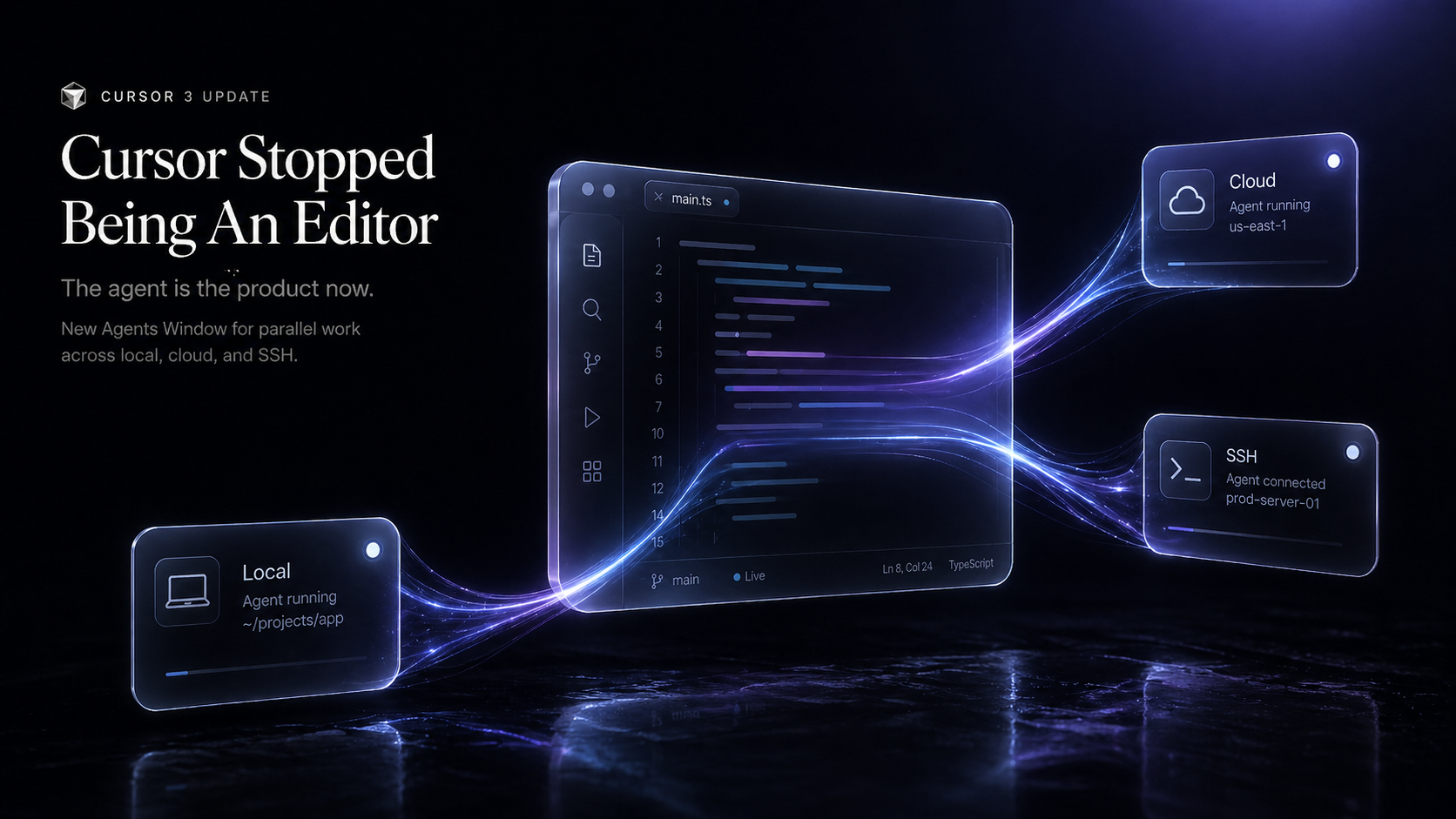
Cursor shipped an SDK. You can now run their full agent stack outside the editor.
Until last week it only worked as an app you opened. Now any company can take Cursor's brain and put it inside their own product, their own workflows, their own systems. That's what an SDK does. It turns a closed app into a building block.
Same agent that powers Cursor, available as code you can call from anywhere. You pick the model. Composer, Claude, GPT, whatever fits.
This is a bigger move than the framing suggests.
What's In The Box
The SDK gives you the full agent loop. The agent can read files, change them, run commands, navigate large codebases. Everything a human developer does, automated.
You can run agents on your own machine or push them into Cursor's secure cloud. They can plug into deployment pipelines, backend services, customer facing products. All valid targets.
Cursor also open sourced a starter cookbook on GitHub. A coding assistant for the command line, a prototyping tool, an agent powered Kanban board. That last one is the tell. A Kanban board is a project management tool, not a developer tool. They're signaling this is for products real users touch, not just internal scripts.
Real companies are already shipping with it. Rippling, Notion, C3 AI, Faire. They're using it to build background agents, to turn bug reports into ready to ship code automatically, to keep their software healthy without human intervention.
Why This Is A Real Shift
Most AI coding tools are editors. You sit in front of them and chat. The value is locked to the seat. One developer, one screen, one session.
An SDK breaks that. The same agent that helps you write code in the editor can fix a bug at 3am while you sleep. It can keep your software clean and updated on its own. It can live inside the product you're selling to your own customers.
The editor was always a wrapper. The agent was always the product. Cursor just made it official.
What Changes If You're Building AI Products
Three things move.
One. Agent quality stops being your differentiator. Cursor's tech is good. Anthropic's is good. OpenAI's is good. Nobody is winning on raw capability anymore. The underlying engines are converging.
Two. The moat moves to context. What does your agent know that the others don't. Your customer data, your internal documents, your domain expertise, your workflows, your history. That's the real work now. The agent is generic. What you feed it is not.
Three. Where the agent lives matters more than which one you pick. Who can trigger it. What systems it can touch. What it's allowed to do. Those answers decide whether your product is something people depend on or something they swap out next quarter.
The Decision In Front Of Builders
If you're building a coding tool, you have a real call to make. Compete with Cursor's tech or build on top of it. Competing is expensive and slow. Building on top lets you focus on the parts your customers actually pay for.
If you're building anything else with AI agents, watch how this evolves. The patterns Cursor exposes, secure execution, automated pipelines, swappable models, are going to be the baseline expectation for any serious AI product within a year.
The model isn't the product. The tech stack isn't the product. What you know about your customers and where you let the agent operate, that's the product. Everything else is plumbing.