
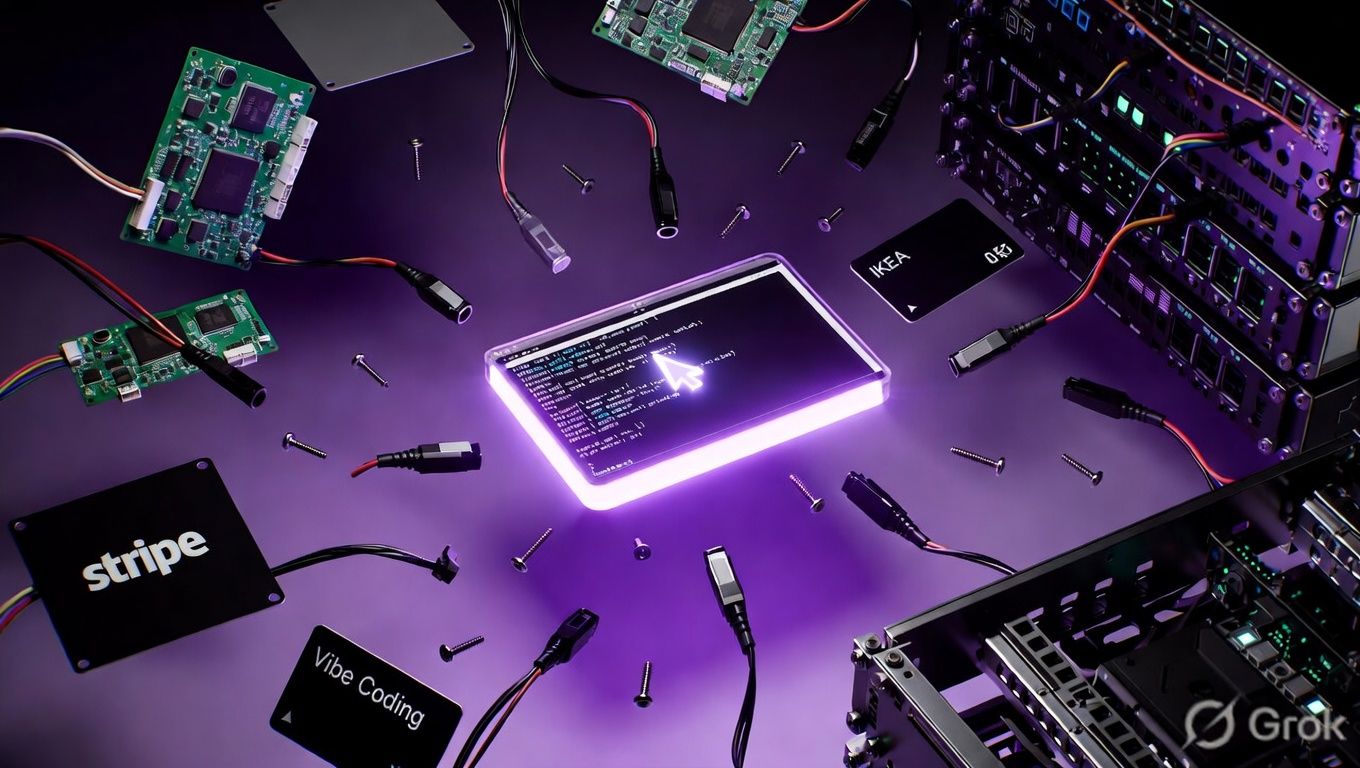
Patrick Collison's tweet on March 26 wasn't casual commentary. The Stripe CEO quoted Andrej Karpathy's year old frustration about assembling modern apps "like IKEA furniture," and then Stripe announced its answer, Stripe Projects, the very same day. Karpathy responded enthusiastically, articulating a vision where "the entire DevOps lifecycle has to become code." The exchange went massively viral within hours, crystallizing the industry's central tension: AI has made writing code trivially easy, but deploying real apps remains agonizingly hard.
The sequence was orchestrated product storytelling at its finest. Problem, resonance, solution. And it landed at a moment when every developer in tech could feel the truth of it.
The Tweet That Set the Stage
On the morning of March 26, 2026, Patrick Collison posted a tweet quoting directly from Karpathy's MenuGen blog post published a year earlier. He referenced Karpathy's description of building MenuGen, a restaurant menu visualizer app that photographs a menu and generates AI images of every dish. The quote highlighted Karpathy's devastating observation: vibe coding menugen was exhilarating and fun as a local demo, but a painful slog as a deployed, real app. Building a modern app is a bit like assembling IKEA furniture.
Karpathy had documented a litany of deployment pain in that original blog post. OpenAI APIs with hallucinated deprecated methods. Clerk authentication requiring roughly 1,000 lines of deprecated code. Stripe payments with TypeScript/JavaScript mismatches. Vercel deploy linting errors invisible during local development. And an endless parade of dashboards, API keys, configurations, and rate limits.
His devastating summary was blunt: he didn't even spend most of his time in the code editor itself. He spent it in the browser, moving between tabs and settings and configuring and gluing a monster. All of this work and state was not even accessible or manipulatable by an LLM. His rhetorical question landed like a punch: how are we supposed to be automating society by 2027 like this?
Collison had discussed this same blog post on stage at Stripe Sessions 2025, telling the audience about "this kind of cool menu app" where you point your phone at a menu and it generates an image of every dish. But now, nearly a year later, he was elevating Karpathy's complaint from conference anecdote to public problem statement. With strategic purpose.
Karpathy's Response: The Agent Native Manifesto
Hours after Collison's tweet, Karpathy responded with a thread that expanded his year old frustration into a forward looking vision. He reiterated that when he built MenuGen about a year ago, the hardest part by far was not the code itself. It was the plethora of services you have to assemble like IKEA furniture to make it real: payments, auth, database, security, domain names, and so on.
Then he laid out the future he wanted: a world where he could simply tell his agent "build menugen" (referencing the post) and it would just work. The whole thing, up to the deployed web page.
He got specific about what that would require. The agent would have to browse a number of services, read the docs, get all the API keys, make everything work, debug it in dev, and deploy to prod. This, he argued, is the actually hard part. Not the code itself.
Two phrases from this response became the intellectual anchors of the discourse. First: "the entire DevOps lifecycle has to become code." Second: "agent native ergonomics." Karpathy was arguing that the bottleneck in software development had shifted entirely from code generation to service orchestration, and that solving it required services to fundamentally redesign their interfaces for AI agents rather than human dashboard clickers.
There should be no need to visit web pages, click buttons, or anything like that for the human, he wrote. It's easy to state, it's now just barely technically possible and expected to work maybe, but it definitely requires from scratch redesign, work, and thought. Very exciting direction.
Stripe Projects: The Answer Drops
Between Collison's problem framing tweet and Karpathy's enthusiastic response, Stripe launched Stripe Projects, a CLI tool that directly addresses the IKEA furniture problem. The product went live at projects.dev with a tagline that could have been written by Karpathy himself: provisioning your app stack is still too manual.
Stripe Projects lets developers, or their AI agents, provision an entire application stack from the terminal. A developer types
``
stripe projects init my-app,
then adds services like
stripe projects add clerk/auth,
stripe projects add neon/database
or
stripe projects add posthog/analytics.
The tool provisions real resources in accounts the developer owns, securely syncs credentials to their .env file, and handles billing through Shared Payment Tokens. That means developers enter payment details into Stripe once and can upgrade service tiers for any provider without leaving the CLI.
Launch partners include Vercel, Railway, Supabase, Neon, PlanetScale, Turso, Chroma, PostHog, Clerk, and RunloopAI.
Crucially, Stripe Projects writes agent skill files into the project directory at initialization. A developer can tell their coding agent "add Turso auth and PostHog on the free tier" or "set up the services this repo needs and explain what changed," and the agent executes the same deterministic, auditable CLI commands a human would. As Philip Thomas, who built Chroma's integration, explained on Hacker News: integrating Stripe Projects felt a lot like adding "Sign in with Google." Stripe acts as a trusted identity and billing provider, but for agents instead of humans.
The strategic choreography was unmistakable. Collison surfaced the pain, Karpathy validated and elevated it, and Stripe shipped the product. All within roughly 12 hours.
The Karpathy Arc: From "Vibe Coding" to "Agent Native Ergonomics"
The March 26 exchange marks the culmination of a remarkable intellectual journey Karpathy has traveled publicly over 14 months.
February 2025: He coined "vibe coding" in what he later called a "shower of thoughts throwaway tweet," describing a style where you fully give in to the vibes, embrace exponentials, and forget that the code even exists. The term went viral, entered Collins Dictionary as a contender for Word of the Year, and earned its own Wikipedia article.
April 2025: Karpathy published the MenuGen retrospective that exposed vibe coding's dirty secret. Writing code was the easy part. He spent most of his time in the browser, configuring and gluing. His proposed solution was prescient: some app development platform could come with all the batteries included. Something opinionated, concrete, preconfigured with all the basics that everyone wants. Domain, hosting, authentication, payments, database, server functions.
December 2025: Karpathy posted his most viral thread ever, declaring that he'd never felt this much behind as a programmer. The profession is being dramatically refactored. He described a "magnitude 9 earthquake" shaking the industry, listing the new concepts developers must navigate: Agents, Sub agents, Prompts, Contexts, Memory, Modes, Permissions, Tools, Plugins, Skills, Hooks, MCP, LSP, Slash Commands, Workflows, and IDE Integrations.
February 2026: Karpathy declared vibe coding "passé" for professionals and introduced "agentic engineering." The new default, he explained, is that you are not writing the code directly 99% of the time. You are orchestrating agents who do, and acting as oversight. He revealed he'd gone from 80% manual coding in November to 80% agent coding by January, describing the feeling as "like I'm cheating."
March 2026: He released AutoResearch, an AI agent that ran 700 ML experiments autonomously in 2 days, discovering 20 training optimizations. Shopify CEO Tobias Lütke tried it overnight and got a 19% performance gain from 37 experiments.
Then came the March 26 exchange with Collison, bringing the full arc to its logical conclusion. If agents can write all the code, the remaining human bottleneck is the non code infrastructure: the IKEA furniture of dashboards, API keys, and service configurations that LLMs literally cannot access or manipulate.
The Community Response: Three Camps
The Hacker News thread on Stripe Projects and broader social media discourse revealed distinct community reactions.
The Enthusiasts saw Stripe Projects as the beginning of a new era. The Chroma integration developer called it "Sign in with Google, but for agents." A Supabase engineer shared that new users could get a Postgres database, Storage, and Authentication for free from a single CLI command without ever leaving the terminal. Others noted that Cloudflare, GitHub, Anthropic, and OpenAI were also positioned to build similar aggregator marketplaces.
The Skeptics raised legitimate concerns. One commenter argued the imperative CLI approach was inferior to declarative infrastructure as code tools like Terraform or OpenTofu, noting that at least a declarative solution can be recorded, validated, and version controlled. Another warned about vendor lock in, pointing out Stripe's incentive to onboard platforms that use Stripe for payments so they can earn on transaction fees. Perhaps the most substantive pushback came from experienced web developers who argued that Rails, Laravel, Django, and Phoenix already solve many of these problems, and that Karpathy's IKEA furniture frustration reflected his self admitted lack of web development background rather than an inherent industry failure.
The Security Hawks offered perhaps the most sobering perspective. A December 2025 analysis of GitHub PRs found AI co authored code had significantly more major issues and higher security vulnerability rates. A researcher discovered that hundreds of Lovable built web apps had exposed sensitive user data with zero authentication. One commenter noted Stripe Projects stores API keys in ordinary config files with no innovative protection against AI driven exfiltration attacks.
The Bigger Picture: Stripe's Play for the AI Economy
Collison's tweet was a single data point in what analysts have called Stripe's "twin revolutions" in AI and money movement. In a recent interview, Collison made an extraordinary claim: there's at least a reasonable chance that 2026 Q1 will be looked back upon as the first quarter of the singularity. He backed this with Stripe transaction data showing more businesses forming and performing better simultaneously, a pattern he'd never seen before.
Stripe Projects is the developer infrastructure prong of this thesis. But it sits alongside several other March 2026 Stripe launches that together paint a picture of a company reinventing itself as the orchestration layer for the AI economy.
The Agentic Commerce Suite lets businesses sell through AI agents, with partners including Coach, Kate Spade, and URBN. The Agentic Commerce Protocol (ACP), co developed with OpenAI, already powers "Instant Checkout in ChatGPT" for Etsy sellers. Shared Payment Tokens enable agents to initiate payments without exposing credentials. Stripe's internal Minions, autonomous coding agents, produce over 1,300 pull requests per week on code supporting more than a trillion dollars in annual payment volume. And the company's LLM friendly documentation (add .md to any Stripe docs URL) and MCP server at mcp.stripe.com show a platform rebuilding itself for agent consumers, not just human ones.
The irony is rich. Stripe was specifically named by Karpathy as one of the painful IKEA furniture pieces during the original MenuGen build. The TypeScript/JavaScript documentation mismatch, the need to create Products and Prices through a dashboard, and the dev to prod credential migration were all documented frustrations. Collison quoting this amounts to a public acknowledgment that even Stripe's developer experience fell short of the agent native standard, and a statement of intent to fix it.
What This Moment Means for Builders
The Collison and Karpathy exchange marks a pivot point in the AI development narrative. For the past 18 months, the story has been about AI writing code: vibe coding, Cursor, Copilot, Claude Code. That narrative has reached saturation.
The new frontier, as Karpathy articulated, is making everything around the code agent accessible. Provisioning, authentication, payments, databases, monitoring, deployment, security configuration. The vibe coding market is estimated at $4.7 billion in 2026, with nearly half of new code now AI generated. But the deployment and operations stack remains stubbornly human operated.
Multiple companies are racing to fill this gap. Replit and Lovable try to bundle everything. Google Cloud has launched "Vibe Deploying" as a concept. Former GitHub CEO Thomas Dohmke raised $60M for Entire, an "agent native" development platform. But Stripe's approach is distinctive. Rather than replacing existing providers, it positions itself as the unified provisioning and billing layer that connects them, earning transaction revenue on every tier upgrade. It's an aggregator play, not a bundler play.
The deeper significance is philosophical. Karpathy's original MenuGen blog post ended with a provocation: how are we supposed to be automating society by 2027 like this? A year later, his answer has crystallized. The code itself is solved. The real challenge is redesigning the entire infrastructure ecosystem around agents as first class citizens. Services need CLIs instead of dashboards, markdown docs instead of web pages, and programmatic everything instead of click and configure workflows.
Stripe Projects is one of the first major products built explicitly on this thesis. Whether it becomes the standard or merely the proof of concept, the problem Collison and Karpathy surfaced together on March 26 has become the defining challenge of the next chapter in software development.
What This Means for Your Business
If you're a founder or product leader watching this unfold, the takeaway is clear: the window for building AI powered products has never been more open, and the infrastructure to support them is being laid right now. The barrier isn't code anymore. It's knowing how to architect for this new agent native world.
At Axentia, we build AI products and MVPs for companies navigating exactly this transition. Whether you need to integrate LLMs into your existing product, build an AI native application from scratch, or figure out how tools like Stripe Projects fit into your stack, we've been deep in these waters since day one.
Let's talk about what you're building. Book a free consultation at axentia.in