
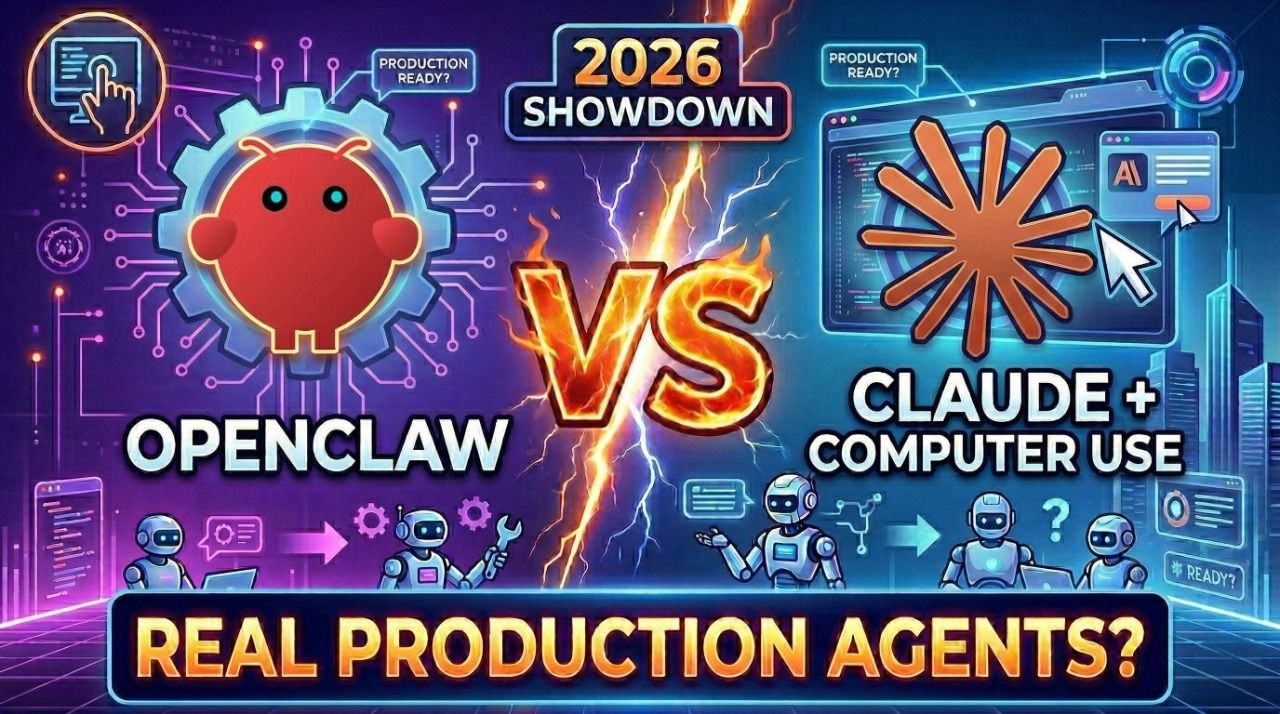
Last week the internet declared OpenClaw dead. Anthropic shipped Dispatch (persistent conversation across phone and desktop) plus Computer Use (Claude can now move your mouse, click buttons, open apps, and run tasks on your Mac). The headlines wrote themselves: “Claude just killed OpenClaw.”
We spent the last 48 hours testing both side-by-side on real workflows. The truth is more nuanced, and far more interesting for anyone shipping agents in production.
What Claude Dispatch + Computer Use Actually Delivers
Dispatch gives you one continuous thread. Start a task on your phone during your commute, switch to desktop, and Claude remembers everything. Pair it with Computer Use and you can text Claude from anywhere: “Pull yesterday’s sales numbers, update the spreadsheet, and email the team summary.” Claude wakes up your Mac (if it’s on), opens Excel, fills cells, attaches the file, and sends the mail.
It feels like magic for individual power users. Setup takes minutes. No CLI. No custom skills. Just prompt and watch.
Strengths
- Extremely low friction for personal or small-team use
- Excellent safety prompts and permission gates
- Seamless cross-device experience
- Fast iteration inside the Claude ecosystem
Realistic limitations (tested yesterday)
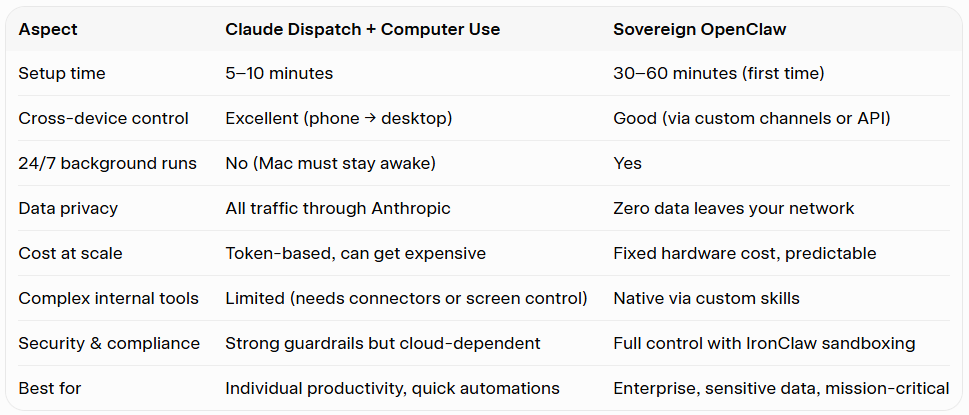
- Your Mac must stay awake and running the Claude Desktop app. Close the lid or let it sleep → task dies.
- It’s still a research preview. Complex multi-step tasks often need 2 to 3 retries.
- Everything routes through Anthropic’s servers. Sensitive company data, internal tools, or proprietary code leave your network.
- Token usage and cost can spike quickly on long-running sessions.
- No true 24/7 background execution without the machine staying powered on.
Where OpenClaw Still Wins for Production
OpenClaw was built from day one as a sovereign agent runtime. You deploy it once on a Mac Mini, old PC, VM, or even a Raspberry Pi in your closet, and it runs 24/7 without anyone’s laptop staying awake.
You define tools and behaviors with clean files (SOUL.md for identity, MEMORY.md for persistent learning across runs, IronClaw for sandboxed execution). Agents can wake up on schedule, read internal Slack, query your database, update GitHub issues, or trigger n8n workflows, all while keeping every byte inside your firewall.
Key advantages in 2026 production environments
- Full data sovereignty: nothing leaves your infrastructure
- True always-on operation (no laptop required)
- Custom tool ecosystem via the skills marketplace
- Predictable cost (run on cheap hardware or your existing servers)
- Full auditability and version control of agent behavior
Head-to-Head Comparison
Real-World Decision Framework
Choose Claude Dispatch + Computer Use if:
- You’re an individual or small team doing personal productivity tasks
- You’re okay with data flowing through Anthropic
- You want the smoothest possible phone-to-desktop experience today
Choose sovereign OpenClaw (or combine both) if:
- You handle customer data, financials, IP, or internal systems
- You need agents that run reliably even when all laptops are closed
- You want predictable costs and full control over updates and security
Many teams we work with now run a hybrid: Claude for quick personal tasks + OpenClaw agents for anything involving company systems or scheduled overnight work.
The Bottom Line for 2026
Anthropic’s new features are impressive and raise the bar for developer experience. They make agentic AI feel accessible to millions of users who don’t want to manage infrastructure.
But production agents have different requirements than personal assistants. When the workflow touches real company data, needs to run 24/7, or must stay fully auditable, sovereignty stops being a nice-to-have and becomes non-negotiable.
At Axentia we ship both kinds of systems every week. We help teams evaluate the right mix of cloud convenience and sovereign control so their agents actually survive contact with reality.
If you’re evaluating Claude’s new Dispatch and Computer Use features and wondering how they fit into a secure, scalable production strategy, book a quick 15-minute architecture call. We’ll map your specific workflows and show you exactly where each tool shines, and where one still beats the other.
The showdown isn’t really Claude vs OpenClaw. It’s convenience versus control.
In 2026, the winners will be the teams smart enough to use both where they make sense.