
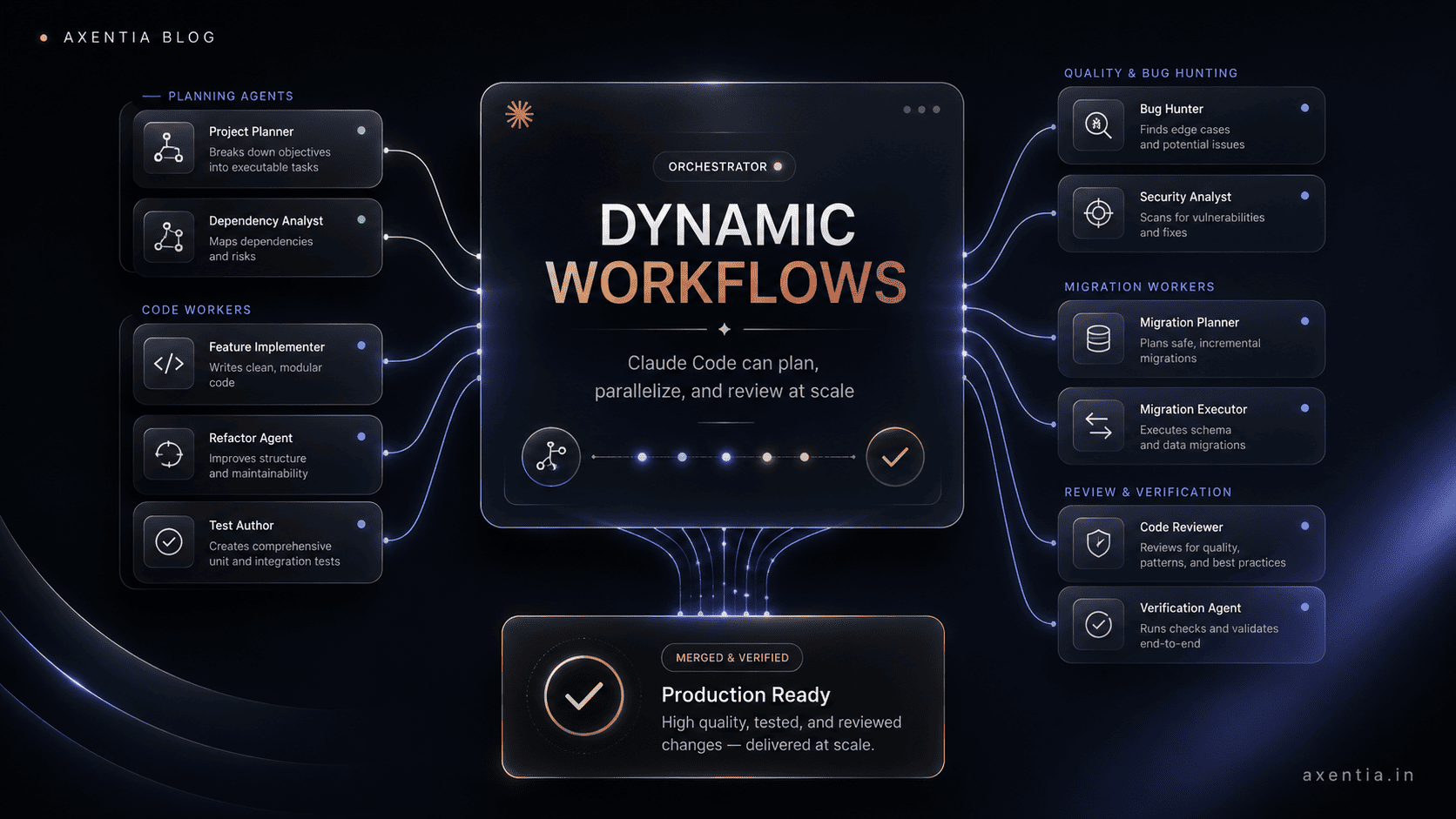
Anthropic recently shipped one of the bigger updates to Claude Code, and it changes what a single AI coding session can take on. It is called dynamic workflows.
Here is the short version. Instead of working through one task in a straight line, Claude can now write its own plan, split a big job into smaller pieces, and run tens to hundreds of agents at the same time. Each agent handles its slice, other agents check that work, and you come back to one clean, coordinated result.
Think of it like a temporary team that assembles itself around the problem, works in parallel, reviews each other, and hands you the finished output.
What this unlocks
The headline is scale. Work that used to be scoped in quarters can now land in days.
A few examples from early users. A bug hunt across an entire service, where agents search in parallel and then independently verify every finding so the report only surfaces real issues. A large migration that touches thousands of files, like a framework swap or a language port, handled end to end. High stakes work you want checked twice, where some agents solve the problem and others actively try to break the answer before it reaches you.
The most striking example so far is the Bun project. A developer used dynamic workflows to port roughly 750,000 lines of code to Rust, with 99.8 percent of the existing tests passing, in eleven days from first commit to merge. Hundreds of agents worked in parallel, with two reviewers on every file.
How you turn it on
There are two ways in. You can simply ask Claude to create a workflow inside Claude Code. Or you can switch on a new setting called ultracode from the effort menu, which lets Claude decide on its own when a task is big enough to warrant one.
It is available in research preview across the Claude Code CLI, the desktop app, and the VS Code extension, plus the API and the major cloud platforms. Max and Team plans have it on by default. Enterprise plans have it off at launch until an admin enables it.
The honest catch
This power is not free. Dynamic workflows burn through significantly more usage than a normal Claude Code session, because you are paying for many agents running at once. Anthropic itself recommends starting with a small, scoped task to get a feel for the cost before you point it at something large. The first time a workflow runs, Claude shows you the plan and asks you to confirm.
Treat it as a precision tool. Reach for it when the task is genuinely big and the cost of a wrong answer is high.
The shift underneath the feature
For founders, the takeaway is not the feature itself. It is the shift it points to.
The expensive parts of building software, the migrations, the audits, the cleanup nobody wants to touch, are becoming work you can delegate to a coordinated swarm of agents and review at the end. The bottleneck moves from how fast your team can write code to how clearly you can define the problem.
That is exactly the kind of leverage we help teams design into their products at Axentia. If you are thinking about how agent driven workflows could fit your own stack, that is a conversation worth having.