
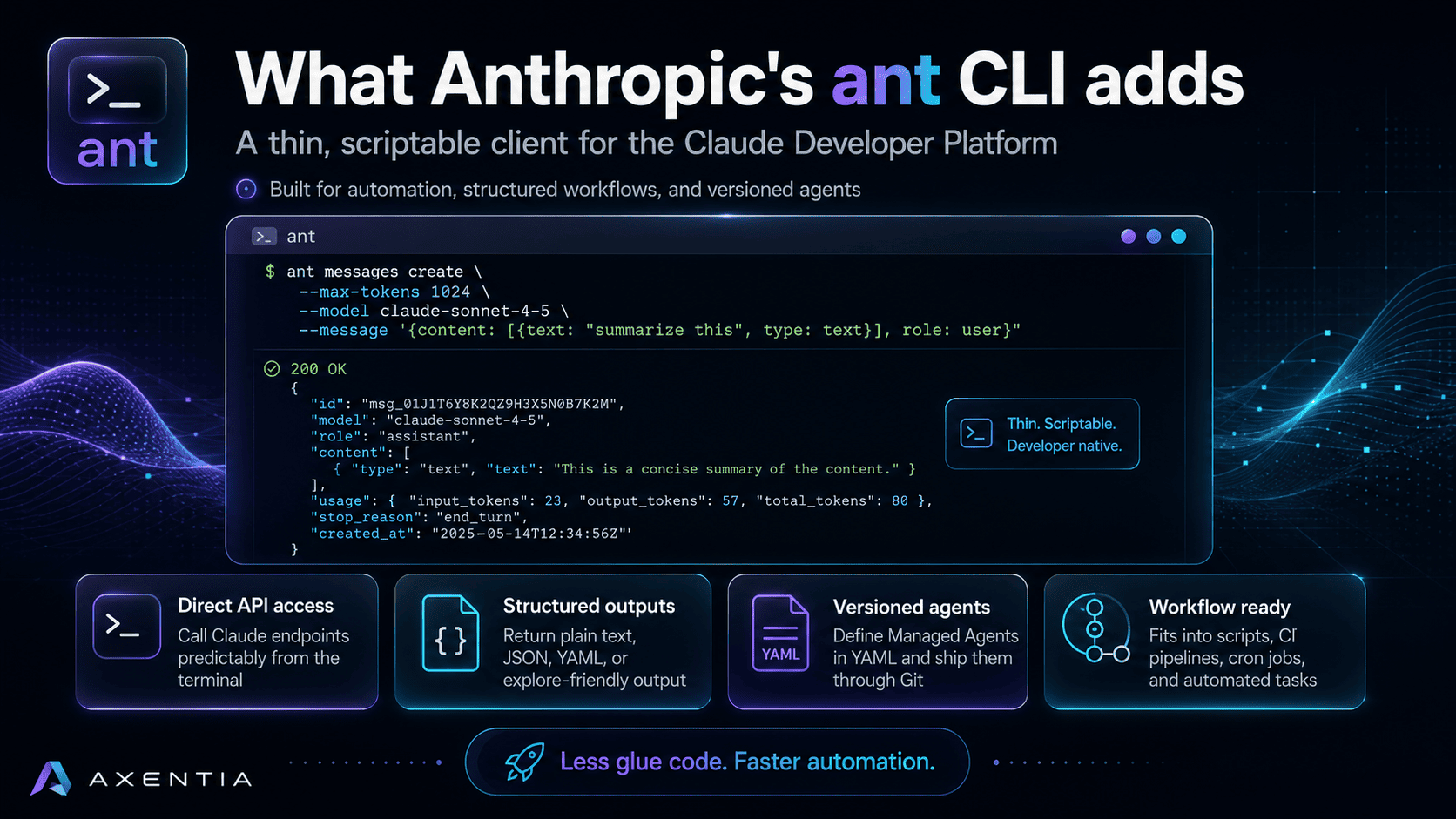
If you build with Claude, the terminal is already familiar ground. Claude Code lives there. It reads your codebase and runs tasks when you describe them in plain language.
So when Anthropic shipped a second terminal tool, the ant CLI, the fair question is what it adds.
The difference is what each is built for.
Claude Code is a collaborator you talk to. You hand it a goal and it works out the steps.
The ant CLI works lower down. It is a thin, predictable client for the Claude Developer Platform. You name the exact endpoint and it does precisely that, nothing more.
That predictability is the point. A tool that does what you type every time is a tool you can hand to a script.
Claude Code keeps a person in the loop. The ant CLI lets a scheduled job, a CI pipeline, or a one line command call Claude with no one watching.
What the ant CLI does
A single command sends a prompt to the Messages API and prints the answer back:
ant messages create \
  --max-tokens 1024 \
  --model claude-sonnet-4-5 \
  --message '{content: [{text: "summarize this", type: text}], role: user}'
The commands follow one clean pattern across the platform. You pass files with a simple @filename reference. You pick how output comes back: plain text, JSON, YAML, or an interactive explore view.
That output flexibility matters. Clean JSON slots straight into the scripts a small team already runs. Claude becomes a step in a workflow, not a separate place to visit.
Why Managed Agents make this more useful
The CLI shipped alongside Managed Agents, and that is where it gets useful.
You define an agent as a YAML file, then check it into Git like any other code. Your normal pipeline deploys it. Agents get versioned, reviewed, and shipped the same way your app is.
For a founder, the takeaway is simple. The behaviour of your AI features stops living in someone's head. It lives in a file your team can read and trust.
Why it lands for lean teams
The theme across all of it is less glue code.
Wiring Claude into an automated process used to mean wrapper code, auth handling, and parsing responses by hand. Most of that now collapses into a few commands.
For a small team, that is the difference between a prototype taking an afternoon and taking a week.
At Axentia we watch tools like this because they change what a lean team can ship. The teams who win with AI rarely have the biggest models. They have the shortest path from an idea to a working version of it.
If you are sitting on an AI idea, the answer to whether your small team can build it keeps getting easier.