
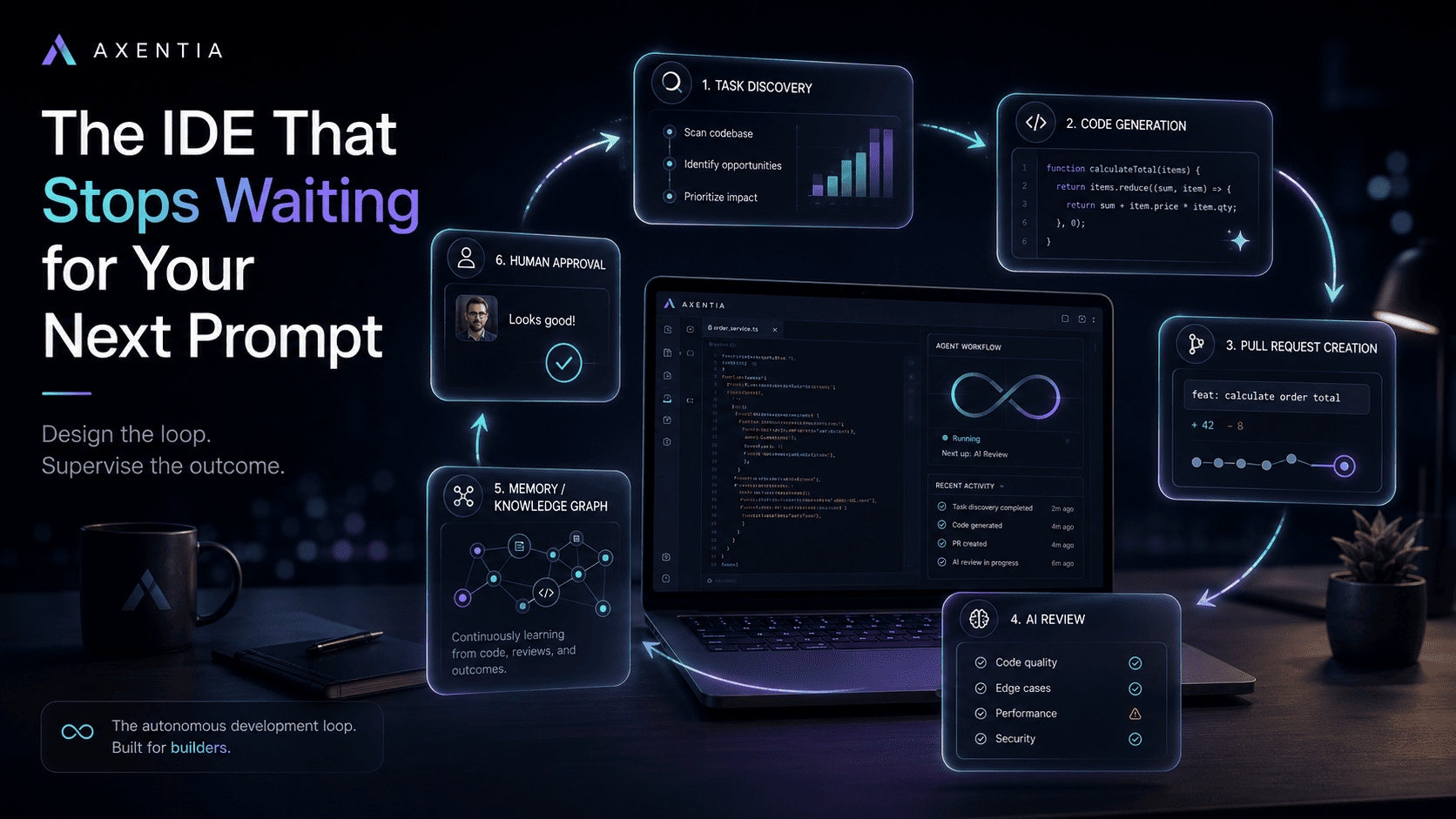
Most AI coding tools carry a cost that never shows up on the invoice. They wait. You write a prompt, the agent acts, and then it sits idle until you write the next one. For a founder shipping a product, that turns you into the bottleneck. Every feature, every fix, every small improvement still routes through your attention.
Adi (@xadisingh), founder of Aradotso, recently announced Ara to attack exactly that pattern. Ara runs an autonomous loop that interfaces with coding agents, opens its own pull requests, and moves a codebase forward without someone standing over it. The pitch is simple. Stop prompting the agent. Start designing the loop the agent runs inside.
What Ara actually does
Ara ships as a Mac app that behaves less like an editor and more like a teammate who never logs off. The demo shows it suggesting the next useful task, holding context in a knowledge graph so it remembers how your codebase fits together, and then doing the work. It opens GitHub pull requests on its own. A Claude bot reviews them. You read a summary instead of a wall of diffs.
The framing borrows from Peter Steinberger (@steipete), who has argued that the real skill is designing agent loops rather than hand feeding agents one instruction at a time. Ara turns that idea into a product. The loop finds work, ships work, learns the method as a reusable skill, and starts again. Adi claims this delivers roughly 10X usage efficiency, meaning far more shipped per hour of human steering.
What changes when the loop runs itself
If you run a small team, you already know the math. Engineering time is your scarcest resource, and a surprising amount of it goes to maintenance, cleanup, and the small improvements that never reach the roadmap but quietly decide whether your product feels solid.
A self-improving loop changes where your people spend attention. Instead of writing prompts all day, they review outcomes. Instead of remembering what needs doing, they let memory and scheduling carry that load. Work that used to wait for a free afternoon can run in the background while the team focuses on the decisions only humans should make.
There is a real caution here too. An autonomous loop that opens pull requests is only as safe as the review around it. Hands off does not mean unwatched. The teams that win with tools like Ara will be the ones that build strong checks, clear guardrails, and a human who owns the merge button.
The bigger pattern
Ara is one product, but it points at a direction. Coding agents are moving from tools you operate to systems you supervise. Founders who internalize that shift early will compound small gains into a real speed advantage, because their codebase keeps improving on nights and weekends while everyone else is still typing prompts.
That shift is exactly the kind of thing we think about at Axentia. We help founders fold agentic infrastructure into real products, with the guardrails that keep autonomy from turning into chaos. If you are trying to work out where loops like this fit into your build, we are happy to think it through with you.